In brief:
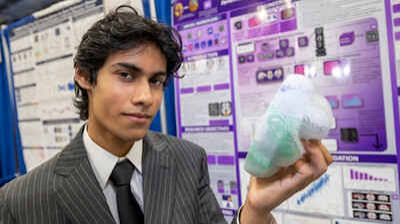
- Innovator: Arika Kundu, a 13-year-old seventh-grader at Minnetonka Middle School East in Shorewood, Minnesota.
- Project Name: "LIGNEX - A novel biosorption based approach that uses agricultural waste material to eliminate pesticide residues from fresh produce."
- Technology: Uses biosorption to transform peanut shell waste into a filter that attracts and binds harmful pesticide residues on produce.
- Recognition: Selected as one of 10 national finalists in the 2026 3M Young Scientist Challenge.
- Next Steps: Summer mentorship with a 3M scientist leading to the final competition in October for a $25,000 prize and the title of "America's Top Young Scientist."
In a bid to make fresh produce safer, 13-year-old Arika Kundu of Shorewood, has invented a low-cost filtration method made entirely from discarded peanut shells.
Her project, LIGNEX, utilizes biosorption—a process where natural materials attract and bind specific chemicals like a sponge—to trap pesticide residues remaining on fresh fruits and vegetables. By repurposing agricultural waste, Kundu's design offers an eco-friendly and practical alternative to standard washing, which often leaves behind trace chemicals.
Kundu's innovation earned her a place as one of ten national finalists in the 2026 3M Young Scientist Challenge. She will work one-on-one with a 3M scientist over the summer to refine her prototype before presenting it at the 3M Innovation Center in October, where finalists will compete for $25,000 and the title of "America's Top Young Scientist".