In Brief
- Researchers formally described Dysphaea assamensis using five male specimens collected in the Karbi Anglong district of Assam in mid-2026.
- The discovery clarifies decades of misidentification across Northeast India and Bangladesh, where populations were incorrectly classified as Dysphaea walli (Sapphire Torrent Dart).
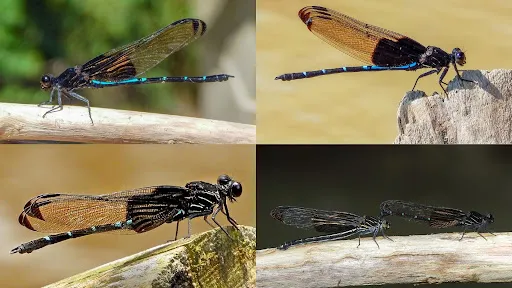
- The newly classified species features intricate blue dorsal patterns on its black abdomen and distinct wing-base patch structures that separate it from D. walli.
- The research was spearheaded by scientists from Dibrugarh University, Dr Vishwanath Karad MIT World Peace University, the Zoological Survey of India, and Debraj Roy College.
Scientists Resolve Century-Old Taxonomic Mystery With Discovery of New Damselfly Species in Assam
In a major breakthrough for Asian entomology, a team of Indian researchers has formally described a new damselfly species, Dysphaea assamensis, originating from the Karbi Anglong district of Assam. The formal description successfully resolves a taxonomic mix-up that persisted for nearly 100 years across Northeast India and Bangladesh.
The collaborative research effort was led by experts from Dibrugarh University, Dr Vishwanath Karad MIT World Peace University, the Zoological Survey of India (ZSI), and Debraj Roy College.
Solving a 99-Year Taxonomic Confusion
Since 1927, populations of this torrent-dwelling damselfly across northeastern India and neighboring Bangladesh were consistently misidentified as Dysphaea walli (commonly known as the Sapphire Torrent Dart), a species native to Myanmar.
Detailed field surveys conducted in May and June 2026 along lowland forest streams near the Nambor and Garampani wildlife sanctuaries enabled scientists to collect five male specimens for detailed anatomical examination. Morphological analysis confirmed that the Indian populations possess distinct physical characteristics, establishing them as an entirely unique species.
Distinctive Features and Ecological Importance
Dysphaea assamensis differs significantly from its Myanmar counterpart in its coloration and wing structures. Male specimens display intricate blue dorsal markings across their black abdominal segments and possess expanded black patches at the bases of their hindwings.
The identification brings the total number of recognized species within the global genus Dysphaea to ten. Because the species primarily inhabits undisturbed, shaded freshwater forest streams, entomologists emphasize that its presence highlights the rich biodiversity and ecological health of the Indo-Burma biological hotspot.