In Brief:
- BHEEM uses a standardized panel system (comprising 422 panels made of simple geometric shapes like triangles, squares, and pentagons) that pack flat inside a rocket's payload bay and are assembled on-site into pressurized living modules.
- The entire layout of 422 panels can fit into a single payload delivery of SpaceX’s Starship (~800 m³), providing roughly twice the habitable volume of the International Space Station (ISS).
- Designed around functional zones (daily living quarters, medical bays, airlocks, and EVA suit maintenance), BHEEM's tessellated grid allows habitats to seamlessly expand as long-duration crew missions scale up.
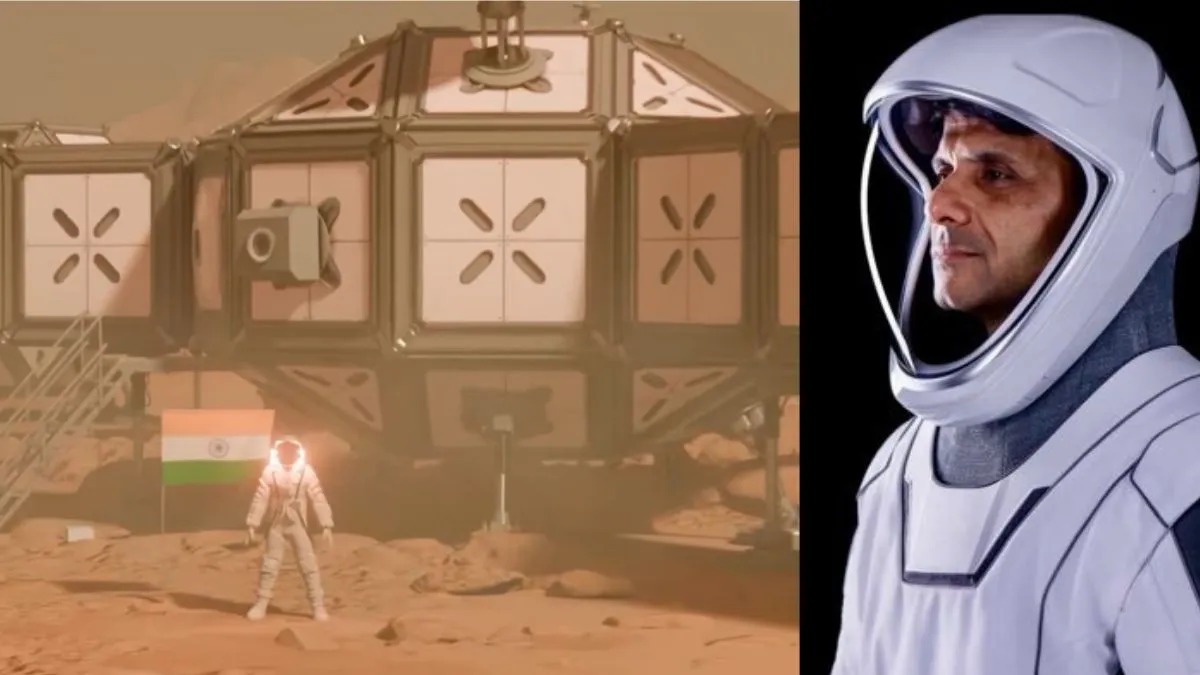
Indian astronaut Group Captain Shubhanshu Shukla, in collaboration with researchers at the Aloke Lab at the Indian Institute of Science (IISc), Bengaluru, released details of an academic research project titled Bharatiya Extraterrestrial Expandable Modular Habitat (BHEEM).
Developed during the Indian phase of Shukla’s astronaut training following his return from Russia, the project proposes a solution to long-duration survival on the Moon and Mars. Moving away from rigid monolithic shells or soft-body inflatables, BHEEM utilizes standard geometric rigid panels (triangles, squares, and pentagons) with uniform side lengths and uniform joinery.
This flat-pack structure allows 422 panels—the total requirement for a full initial base—to be stacked efficiently within a single payload transport like SpaceX's Starship. Once deployed, the modules can be assembled into self-contained, pressurized environments configured with independent life support systems, offering twice the volume of the ISS while simplifying maintenance, local repairs, and scalable layout expansion.