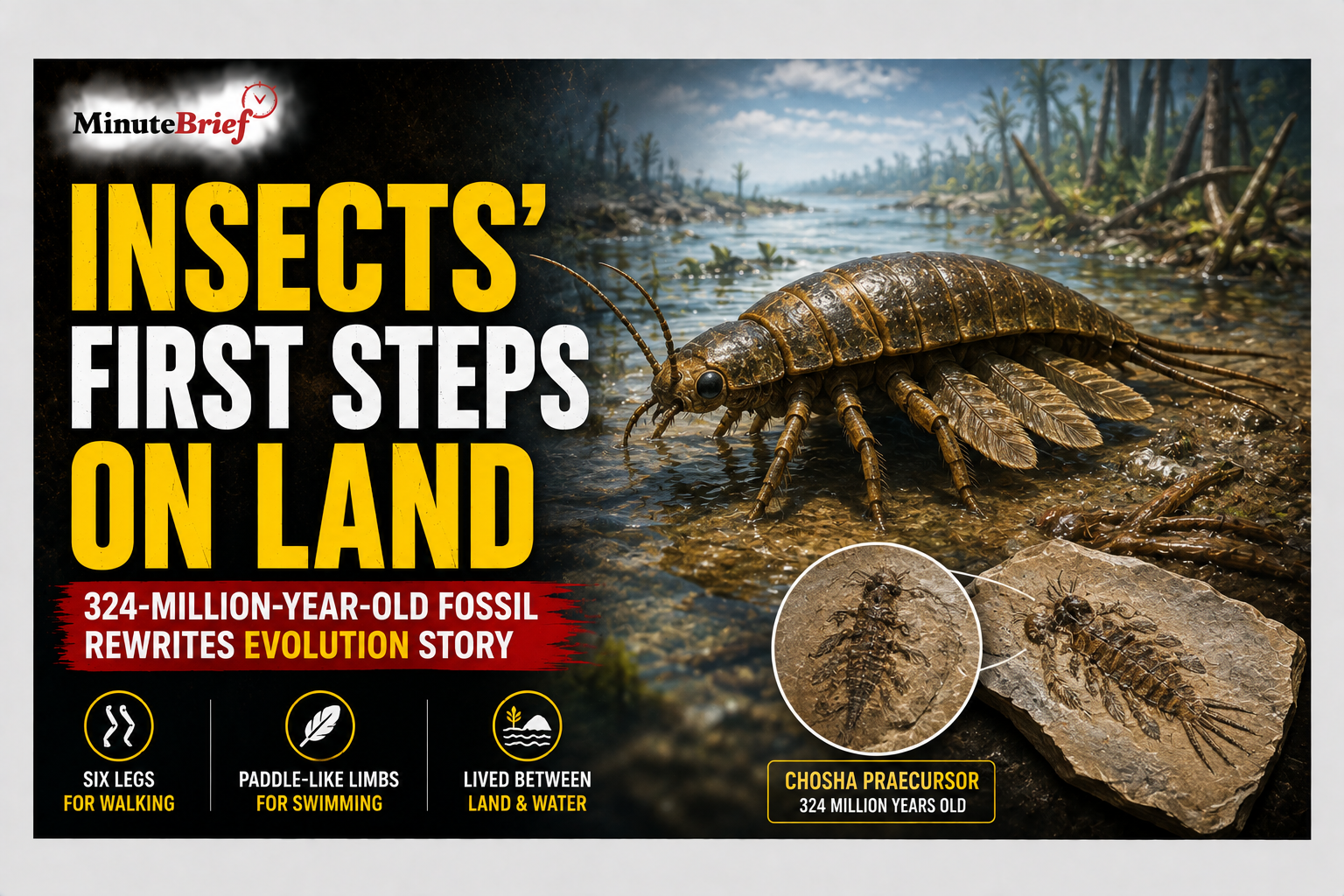
Insects are the most diverse animals on Earth, but how their aquatic ancestors moved to land has long been a mystery. A 324-million-year-old fossil species—Chosha praecursor—shows they didn't make an abrupt jump to dry ground. Instead, early insects spent an extended period living an amphibious lifestyle.
Published in Nature by researchers at the Chinese Academy of Sciences and the University of Cambridge, the discovery reshapes early animal evolution.
Key Discoveries
- The Evolutionary Bridge: C. praecursor had six walking legs and tail filaments, but it also retained paddle-like abdominal limbs for swimming.
- Fulfilling an 80-Million-Year Gap: Combined with other stem insect fossils, this specimen fills a long-standing blank spot in the hexapod fossil record.
- Gradual Limb Loss: The findings show that insects slowly lost their extra abdominal legs over millions of years as they transitioned from water-dwelling crustaceans to six-legged terrestrial bugs.
Life on the Ancient Coast
Discovered in western Texas, the 32-millimeter-long fossils were misidentified for years as crustacean larvae before advanced imaging revealed adult female stem insects.
Living in shallow coastal deltas, these amphibious creatures fed on decaying plants and fungi, acting as early decomposers along the boundary where land met water.
Source: Science Daily