In Brief:
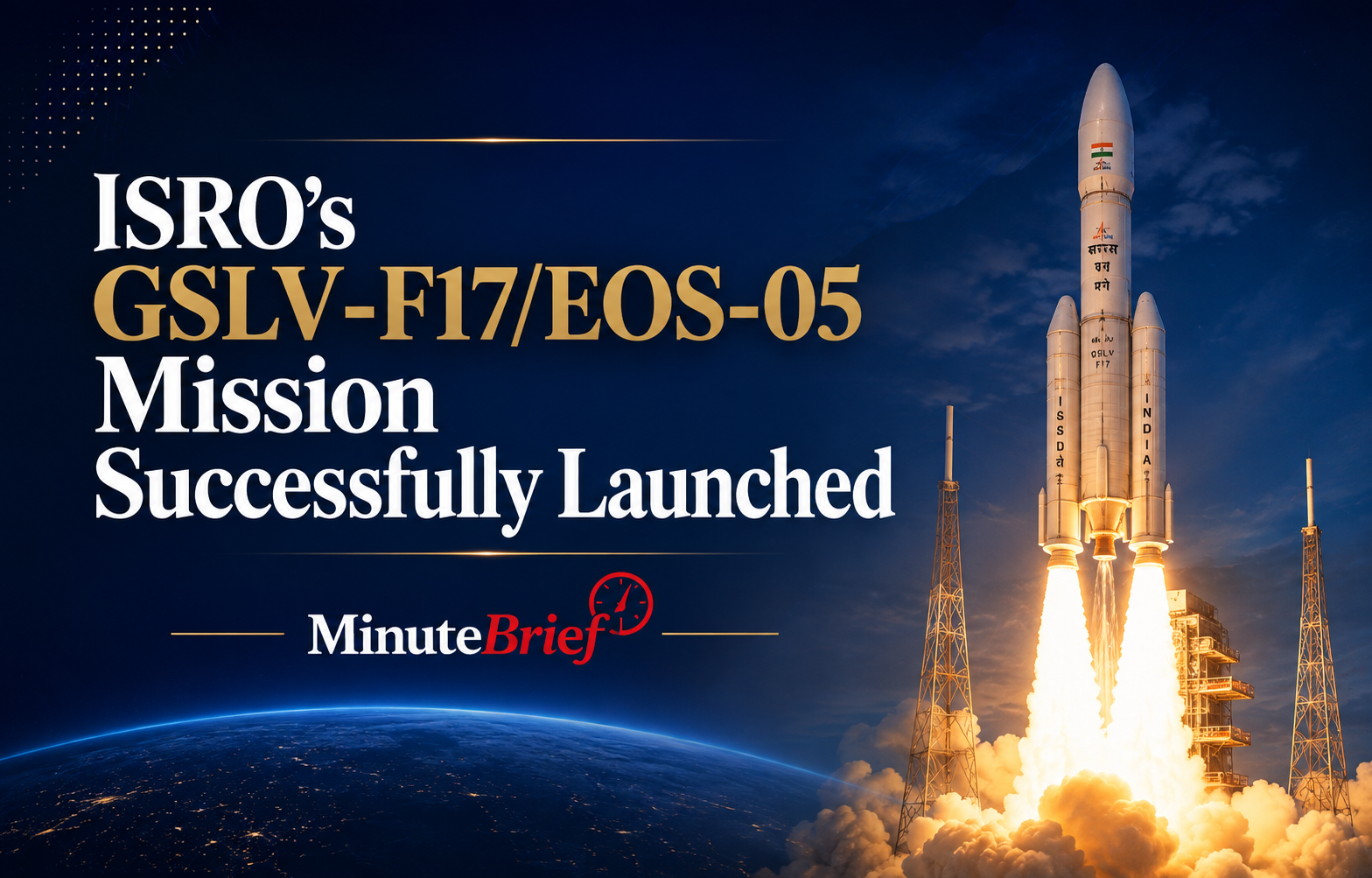
- Mission Overview: The 51.7-metre tall Geosynchronous Satellite Launch Vehicle (GSLV-F17) lifted off at 02:55 AM IST from Sriharikota's Second Launch Pad and precisely injected the payload ~18 minutes into flight.
- India's First Geo-Imaging Satellite: EOS-05 (also known as GISAT-1A) is India's first dedicated Earth observation satellite operating from a geosynchronous orbit (~36,000 km altitude), allowing real-time monitoring and imagery every 30 minutes.
- Replacing EOS-03: The mission replaces the EOS-03 (GISAT-1) satellite lost during a GSLV cryogenic stage failure in August 2021.
- Payload Record: Weighing 2,367 kg, EOS-05 is the heaviest satellite successfully placed by a GSLV into sub-GTO.
ISRO successfully launched the GSLV-F17 mission carrying the state-of-the-art EOS-05 Earth observation satellite on September 4, 2026, at 02:55 AM IST from the Satish Dhawan Space Centre. In a textbook 19-minute flight, the rocket successfully deployed the 2,367-kg spacecraft into its designated sub-Geosynchronous Transfer Orbit.
Operating from a geostationary vantage point about 36,000 km above Earth, EOS-05 will provide continuous, near-real-time imaging across visible, infrared, multi-spectral, and hyperspectral bands. It will support national applications in disaster monitoring (cyclones, cloudbursts, floods), forestry, agriculture, and oceanography.