In Brief:
- Investigators are launching a "follow the money" probe targeting digital payment trails, UPI transfers, and crypto wallets tied to commercial-quantity drug cases.
- Law enforcement will invoke Section 68F of the NDPS Act to freeze and confiscate proceeds of drug crime, including land and vehicles.
- Kerala has constituted a dedicated Anti-Narcotics Investigation Team under IG Putta Vimaladitya to dismantle high-value networks with interstate and international links.
- Specialized units under "Toofan Strike" will target transit hubs, while portable fingerprint scanners and GIS hotspot mapping are deployed for on-spot checks.
- Since launching in June 2026, the operation has registered over 10,900 cases and resulted in nearly 11,800 arrests across the state.
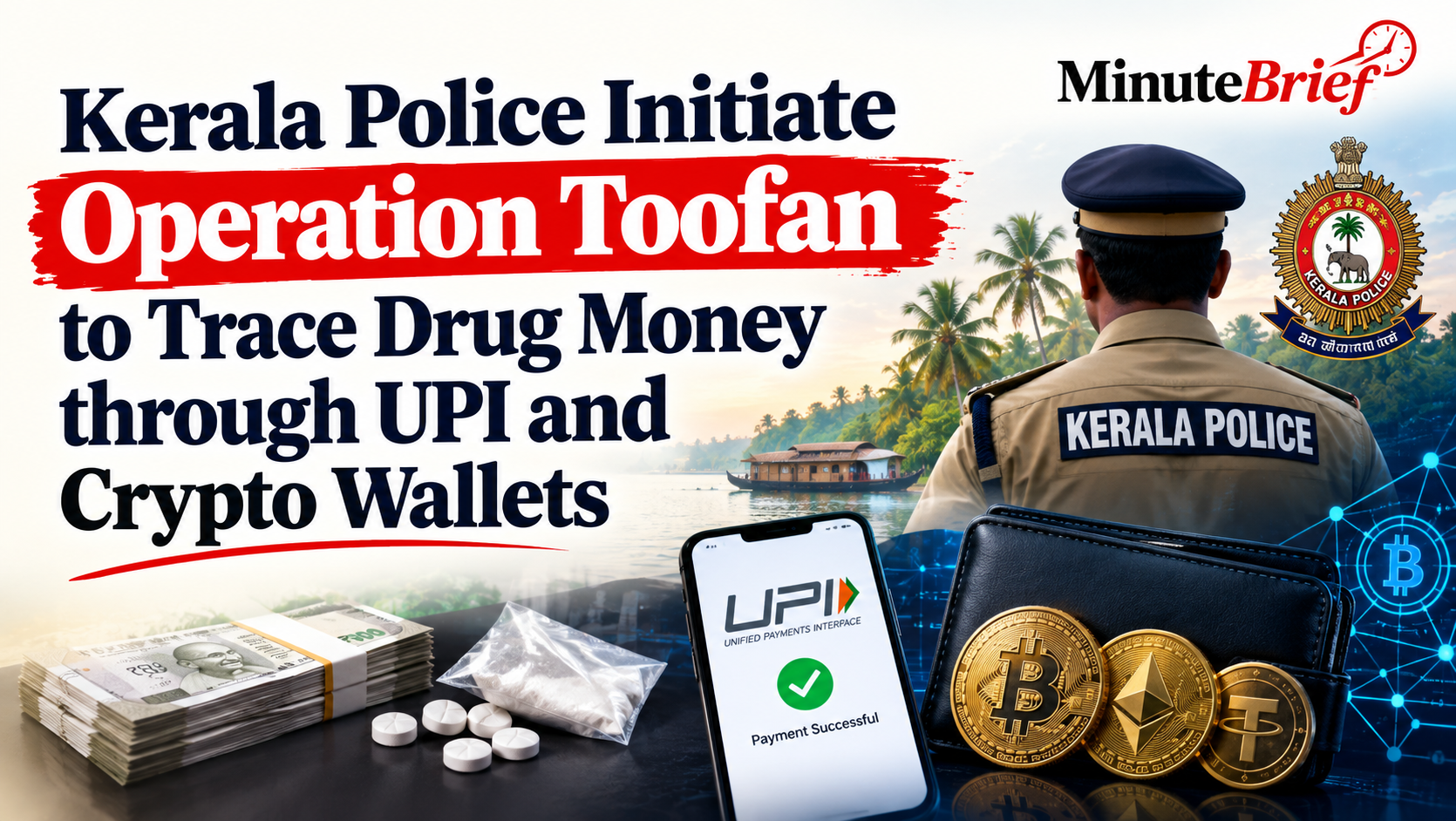
Kerala Police have expanded the scope of "Operation Toofan: The Narco Hunt" to aggressively target the financial infrastructure of illicit drug networks across the state. Under new operational guidelines issued for every commercial-quantity drug case, law enforcement teams will mandate a "follow the money" investigation tracing bank statements, digital UPI payment trails, and crypto wallets. The strategy empowers authorities to apply Section 68F of the Narcotic Drugs and Psychotropic Substances (NDPS) Act, allowing the state to freeze and confiscate illegally acquired properties, vehicles, and digital assets associated with drug syndicates.
The shift toward digital financial forensics accompanies the creation of a specialized Anti-Narcotics Investigation Team, led by Inspector General Putta Vimaladitya, operating across Thiruvananthapuram, Ernakulam, and Kozhikode. Alongside tactical field interdictions by the "Toofan Strike" enforcement arm along major transit corridors, the campaign also incorporates "Toofan Care"—a public health framework designed to offer rehabilitation support to first-time users and individuals struggling with addiction rather than processing them solely through criminal detention. State authorities report that the multi-agency drive has reduced local drug supplies by 20 to 30 percent since its launch.