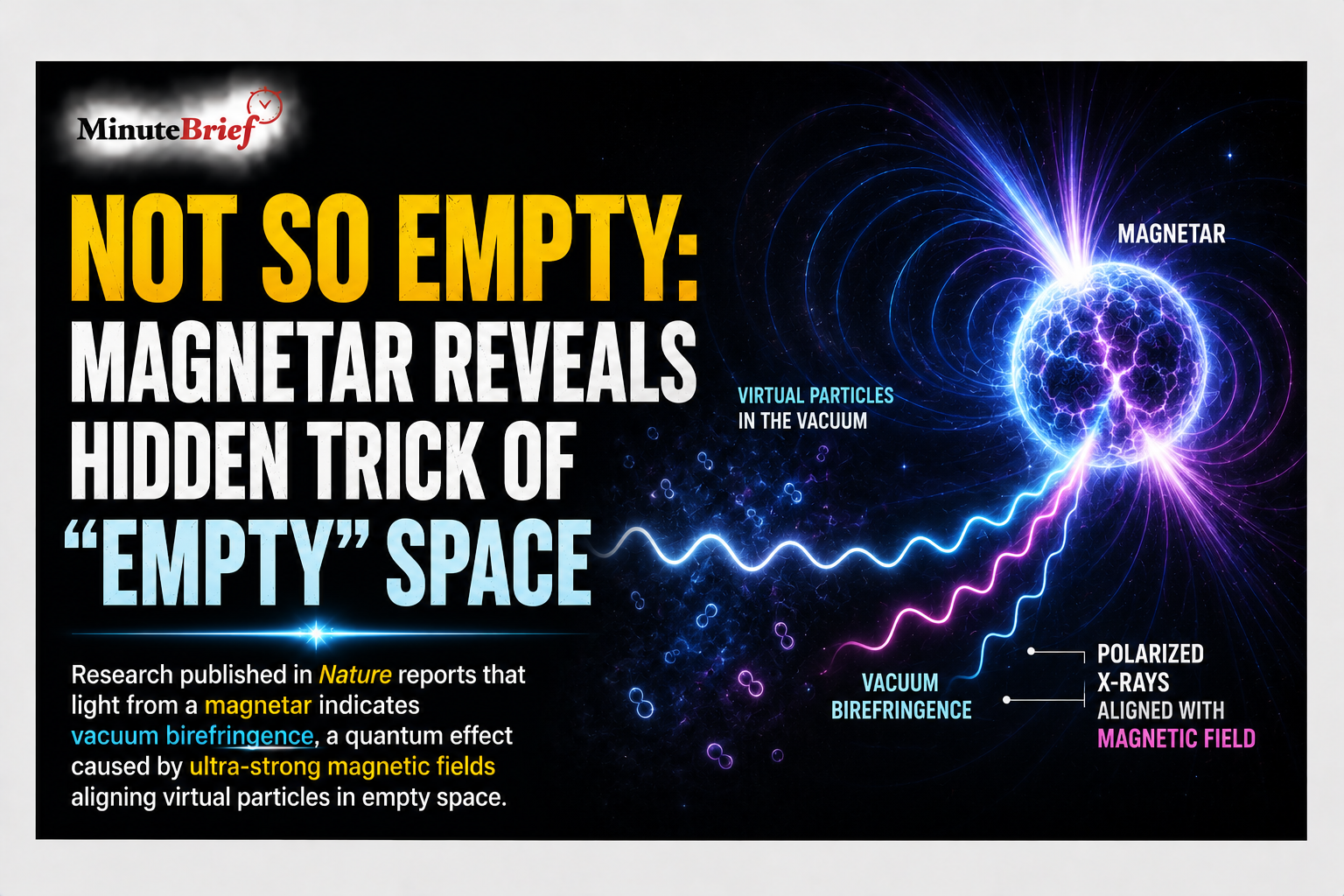
Nearly 90 years after Werner Heisenberg predicted that empty space isn't actually empty, astronomers may have finally caught a quantum phenomenon called vacuum birefringence in action.
Published in Nature, research led by physics graduate student Rachael E. Stewart examined light from a magnetar to observe how extreme magnetic forces alter light passing through a vacuum.
The Quantum Void
According to quantum mechanics, even a total vacuum flickers with "virtual particles" constantly appearing and disappearing.
When exposed to an ultra-strong magnetic field, these virtual particles line up, causing empty space to act like a prism—a phenomenon known as vacuum birefringence. However, testing this requires a magnetic field over 100 million times stronger than anything humans can create on Earth.
Cosmic Laboratories
To find such extreme conditions, scientists turned to 1E 1547.0-5408, a magnetar (a rare type of neutron star with immense magnetic fields).
- Ideal Alignment: Using CSIRO's Murriyang radio telescope, NASA’s IXPE, and the NICER telescope, researchers found that the magnetar's magnetic and rotational axes are nearly aligned, providing a clear perspective from Earth.
- Polarized Light Signals: X-rays emitted near the magnetar showed exceptionally high polarization aligned with its magnetic field—a key signature that vacuum birefringence is occurring.
What's Next
While these findings offer compelling evidence for Heisenberg's prediction, researchers are conducting further observations and computer simulations to confirm that no other physical processes are causing the light behavior.
Source: Science Daily