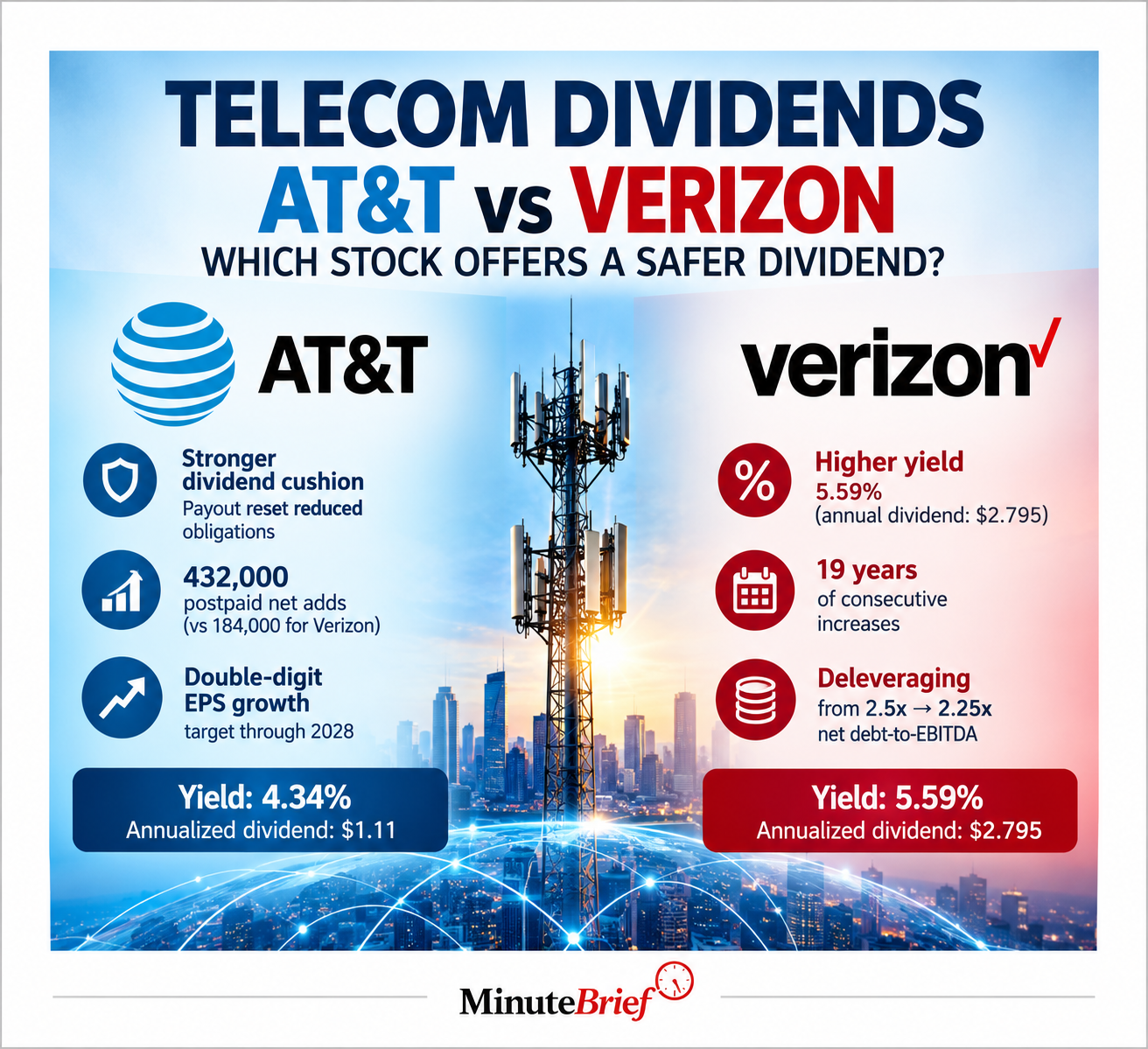
For retirement-focused investors comparing telecom dividends, AT&T has a stronger dividend cushion than Verizon, despite Verizon offering the higher headline yield. Verizon’s trailing dividend stands at $2.795 per share, giving it a 5.59% yield, compared with AT&T’s $1.11 annualized dividend and 4.34% yield. Verizon has delivered 19 consecutive annual dividend increases, while AT&T has kept its payout unchanged since its WBD spinoff reset and plans to maintain that level through 2028.
The major advantage for AT&T comes from dividend coverage after capital spending. Verizon paid $11.481 billion in dividends against $37.137 billion in operating cash flow and $17.011 billion in capex in its latest fiscal year. AT&T paid $8.18 billion in dividends against $40.284 billion in operating cash flow, while spending $20.842 billion on capex. Its payout obligation was reduced significantly from $15.068 billion in fiscal 2021, leaving a larger cash-flow cushion to support the dividend.
The companies also differ in operating momentum and leverage. Verizon is working to reduce its net debt-to-EBITDA ratio from 2.5x toward 2.25x, while AT&T’s leverage is expected to rise to 3.2x following the closing of its EchoStar acquisition. However, AT&T reported 432,000 postpaid phone net additions, more than twice Verizon’s 184,000, and is targeting double-digit adjusted EPS growth through 2028.
Overall, although Verizon offers the higher current yield, the source gives AT&T the edge on dividend safety because of its significantly reduced payout obligation, stronger cash-flow cushion and improving operating performance.