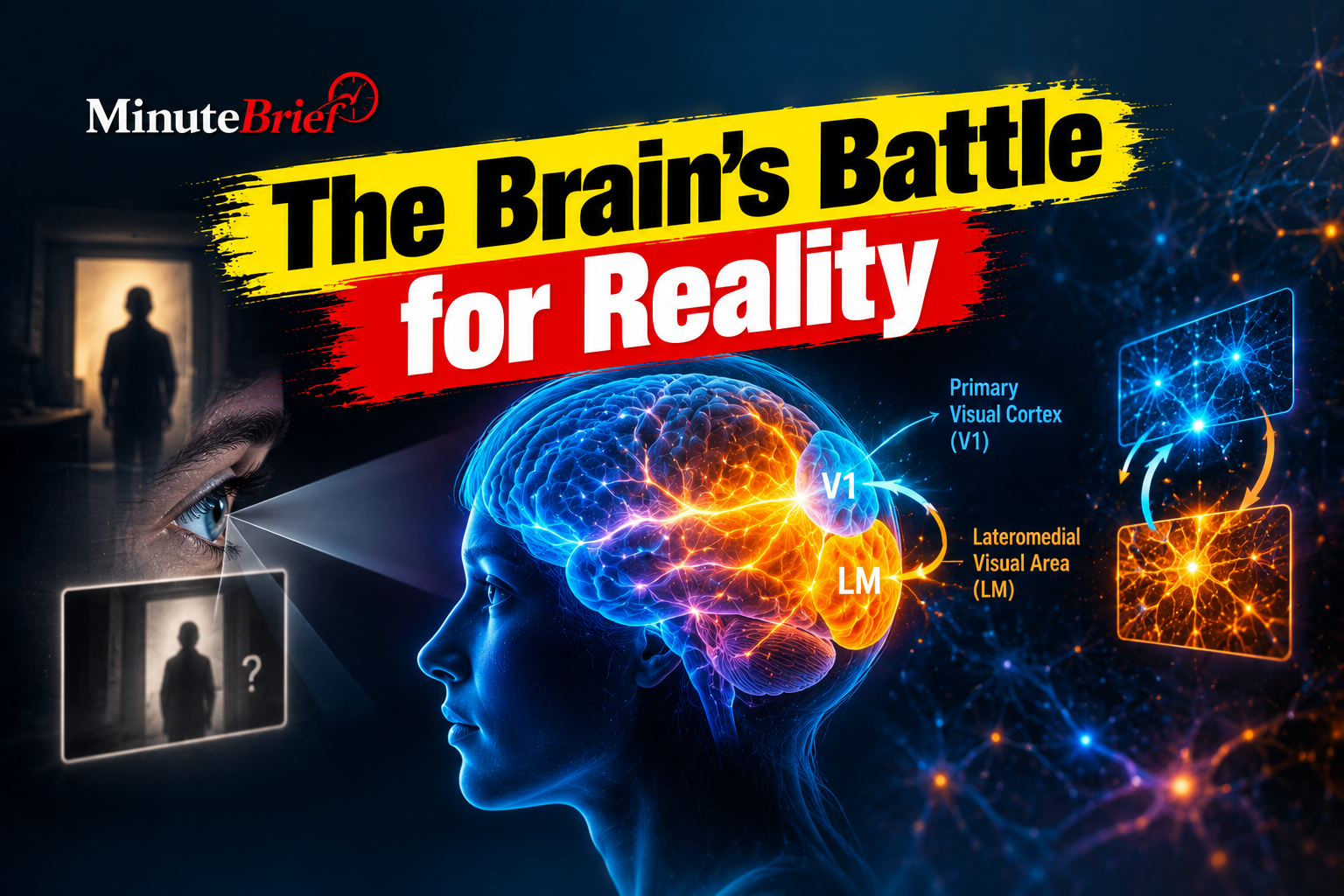
Have you ever mistaken a shadow in a dark room for a person? When what you see doesn’t immediately make sense, your brain works quickly behind the scenes to clear up the confusion.
According to a study in Nature Neuroscience by researchers at Cold Spring Harbor Laboratory, the brain relies on a process called consensus building to resolve conflicting visual information and create a single, unified view of the world.
The Brain’s Visual Processing Team
To process visual information, the brain relies on specialized regions in the neocortex that constantly talk back and forth:
- Primary Visual Cortex (V1): Handles basic visual features received from the eyes.
- Lateromedial Visual Area (LM): Works alongside V1 to build higher-level interpretations.
Because these regions specialize in different details, they don't always agree right away on what you are looking at.
How Disagreements Are Settled
To find out how these areas handle visual conflicts, researchers built a neural network model to track how V1 and LM interact when presented with conflicting patterns. They found a clear rule governing their communication:
- Matching signals persist: When both brain regions agree on an interpretation, their shared signal lasts longer.
- Conflicting signals fade: When the two regions produce mismatched or contradictory information, the disagreement disappears within a fraction of a second.
This rapid filter discards bad or conflicting interpretations before they can cloud your perception.
Why It Matters
Understanding how brain regions negotiate a single reality could help neuroscientists explain what happens when this coordination breaks down in neurological conditions. Beyond biology, these insights could also help computer scientists build better AI systems that know how to evaluate and resolve conflicting data streams.