September offers a packed lineup for skywatchers. From brilliant planetary appearances to the changing of the seasons and a glowing full moon, here are the major celestial highlights to look for this month:
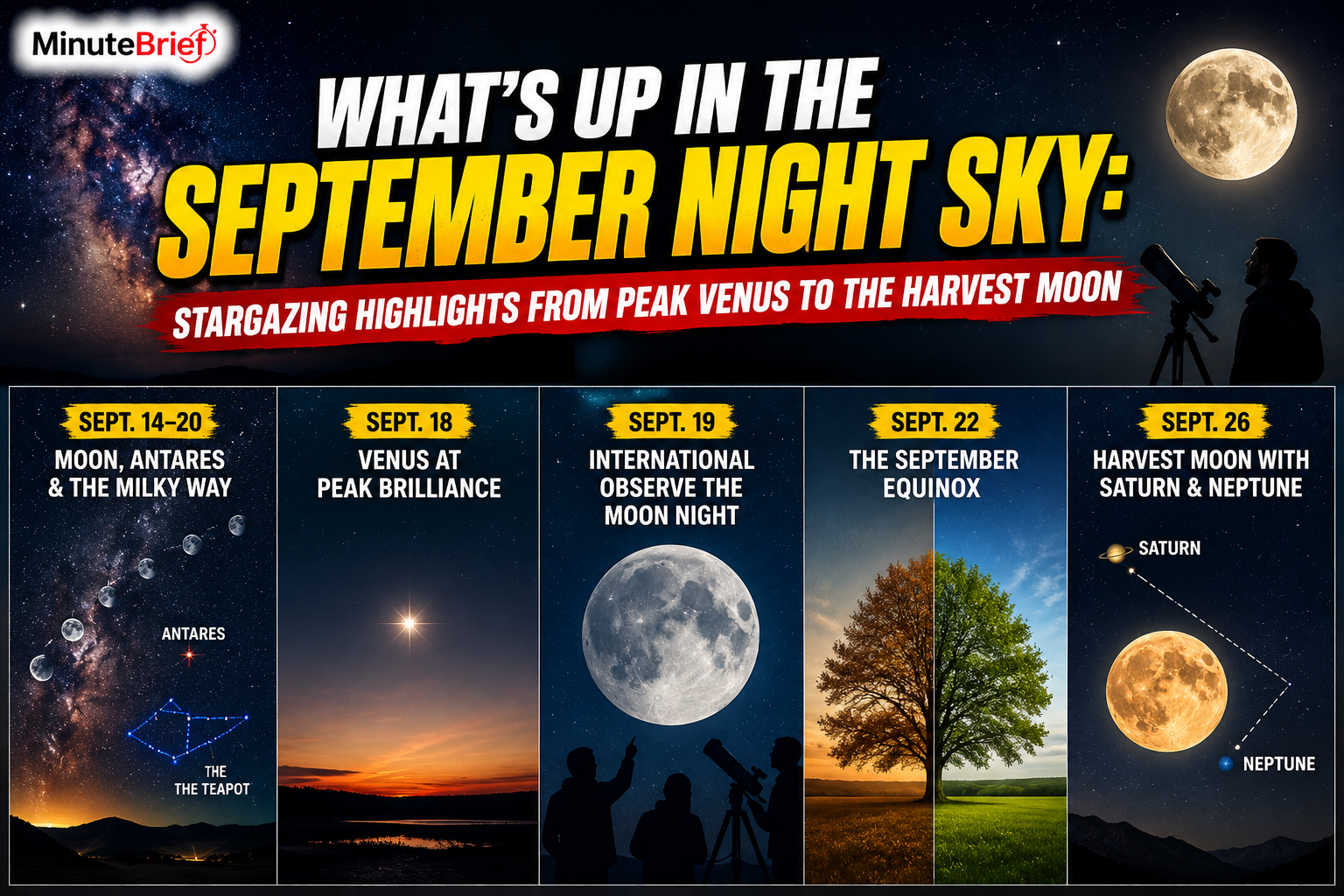
- Sept. 14–20 — Follow the Moon to Antares and the Milky Way: About an hour after sunset, face south to find the Moon. As it shifts across the sky each night, it will pass near Antares, a reddish star marking the heart of the constellation Scorpius. Nearby in Sagittarius, look for the Teapot star pattern. Under sufficiently dark skies, you may spot a faint, cloudy band rising like steam from the spout—pointing directly toward the dense center of the Milky Way galaxy.
- Sept. 18 — Venus at Peak Brilliance: Turn toward the western sky shortly after sunset to spot Venus shining at its brightest for this evening appearance. It will appear low on the horizon, outshining every star around it.
- Sept. 19 — International Observe the Moon Night: Join observers worldwide in looking at Earth's nearest neighbor and learning about lunar science, exploration, and history. You can find events and ways to participate at go.nasa.gov/ObserveTheMoon.
- Sept. 22 — The September Equinox: Fall officially begins in the Northern Hemisphere, while spring arrives in the Southern Hemisphere. On this day, the Sun sits directly above Earth's equator, resulting in nearly equal amounts of day and night across the globe.
- Sept. 26 — Harvest Moon with Saturn and Neptune: Shortly after sunset, the Harvest Moon will rise in the east. Saturn will be easily visible nearby with the naked eye, while the much fainter Neptune forms a broad triangle with Saturn and the Moon (a telescope or binoculars will be required to spot Neptune).