To reach another star within a human lifespan, scientists rely on lightsails—giant reflective sails pushed across space by ultra-powerful lasers. While light can propel these probes to incredible speeds, a study by Harbin Institute of Technology researchers published on arXiv and reported by Universe Today shows that relativity introduces a strange speed bump.
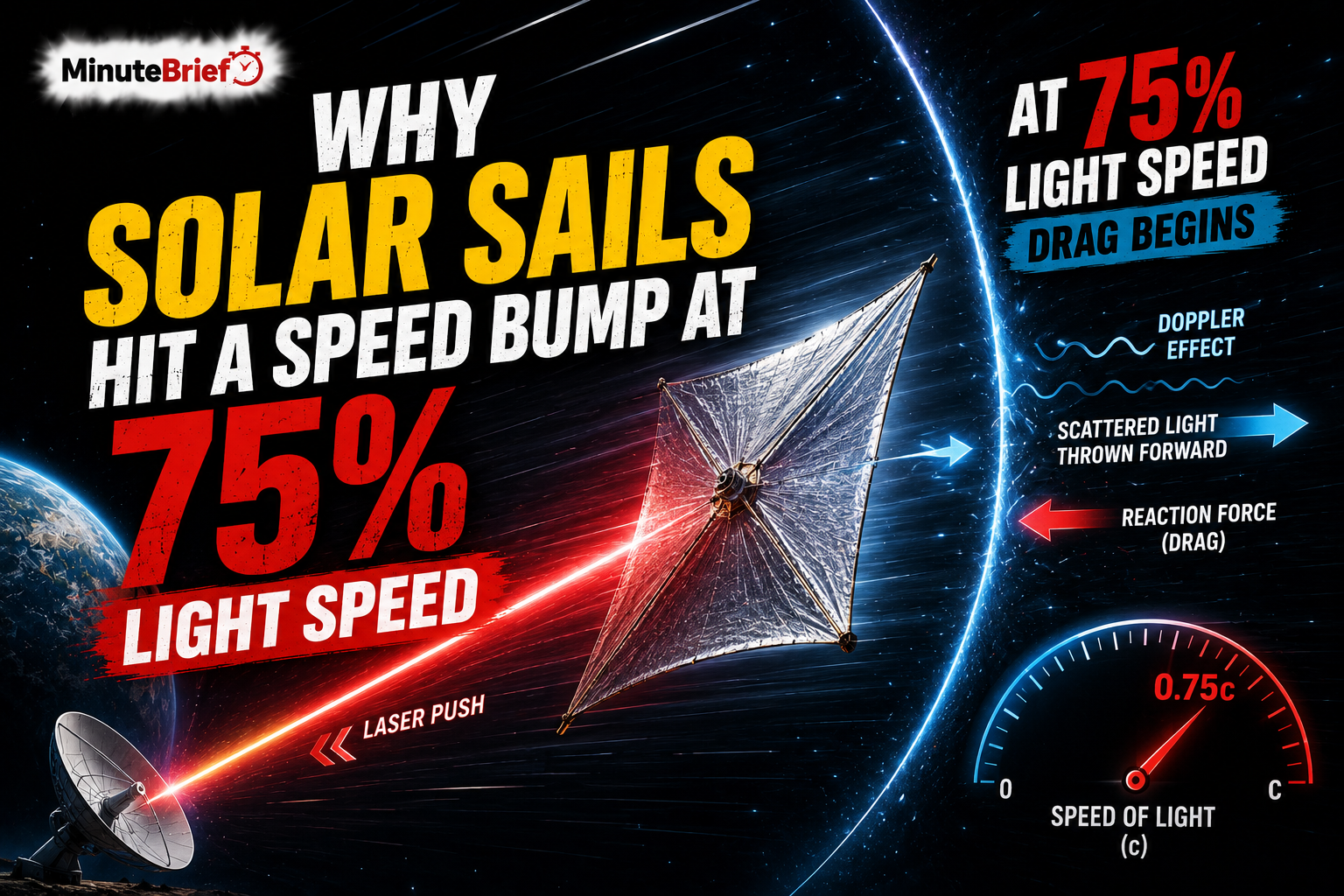
As a solar sail nears 75% of light speed, the very laser pushing it starts creating drag.
How Light Pushes a Spacecraft
Laser photons push a sail through three actions:
- Direct Impact: The force of incoming photons striking the sail.
- Specular Reflection: The extra push as light bounces cleanly off the reflective surface.
- Diffuse Scattering: Minor momentum from light absorbed and re-emitted in random directions.
The Relativistic Speed Bumps
- The Doppler Effect: As the sail races away, incoming laser light shifts to lower frequencies, steadily reducing the force delivered to the spacecraft.
- Radiation Drag at 0.75c: At 75% of the speed of light, an effect called relativistic light aberration takes over. Scattered light is thrown forward relative to an outside observer. Because every action triggers an equal and opposite reaction, shooting radiation forward pushes backward against the sail, turning diffuse scattering into a subtle drag force.
What's Next for Deep Space Probes?
While the net push remains forward, propulsion efficiency drops significantly past 0.75c. Combined with real-world hazards like sail overheating and collisions with space dust, deep-space probes will need advanced engineering.
To overcome these obstacles, researchers are exploring photonic crystals and metamaterials designed to manipulate light scattering, keeping the sail stable and accelerating on its interstellar journey.