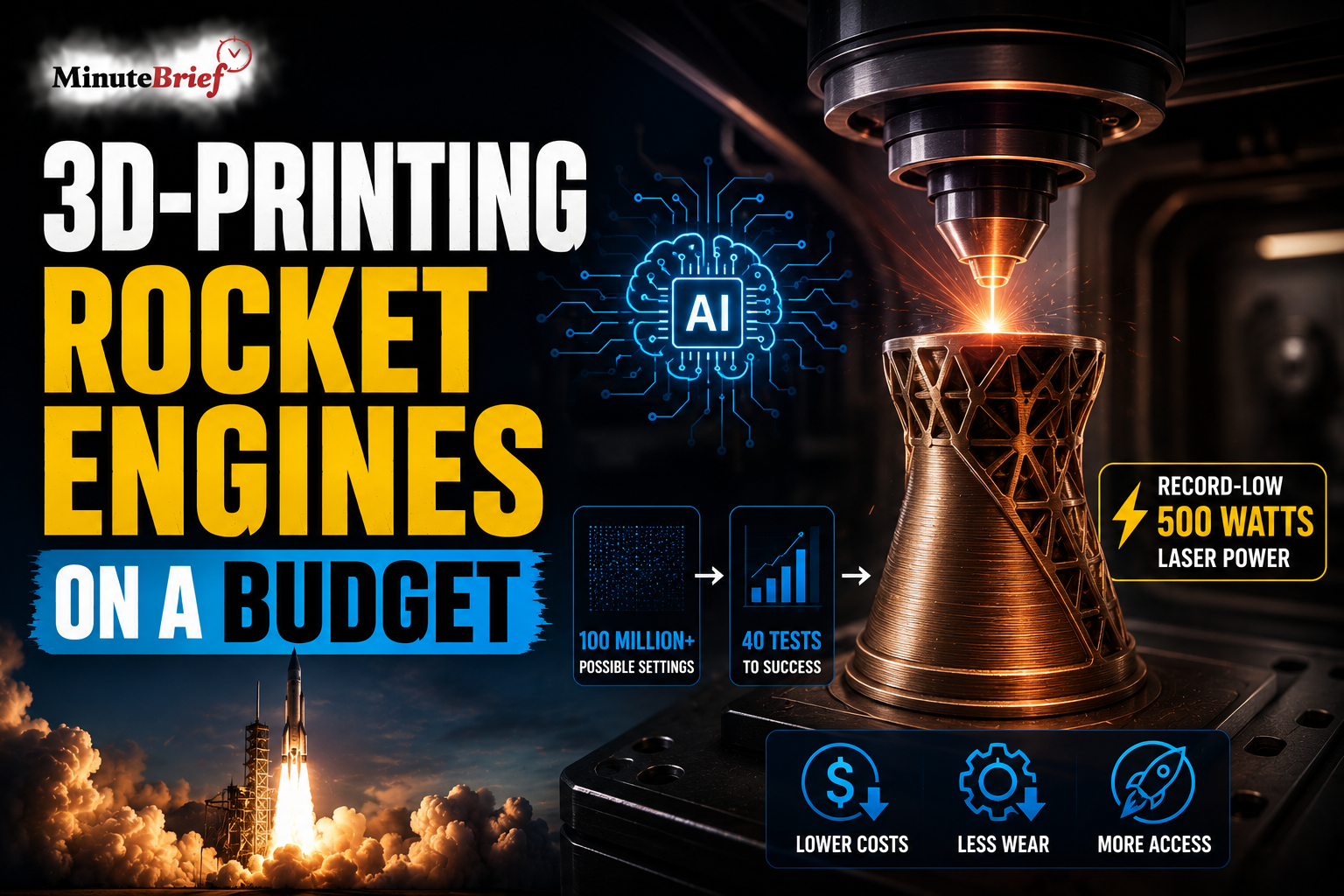
GRCop-42—a copper-chromium-niobium alloy developed by NASA for rocket combustion chambers—withstands extreme heat but typically requires high laser power that 90% of commercial 3D printers can't supply.
Researchers at Washington State University used artificial intelligence to evaluate over 100 million possible settings, enabling the material to be printed on standard, lower-cost commercial equipment.
Key Highlights
- 100M Options to 40 Tests: Published in the Proceedings of the AAAI Conference on Artificial Intelligence, the AI model evaluated data from past failed prints to recommend optimal settings, finding successful parameters in just 40 physical experiments.
- Record-Low Power: The team identified six workable configurations, including one that successfully printed GRCop-42 at a record-low 500 watts of laser power.
- Expanded Access: Operating at lower wattage cuts energy costs, reduces machine wear, and allows smaller labs, universities, and aerospace firms to 3D-print the high-performance alloy using widely available printers.
Source: Science Daily