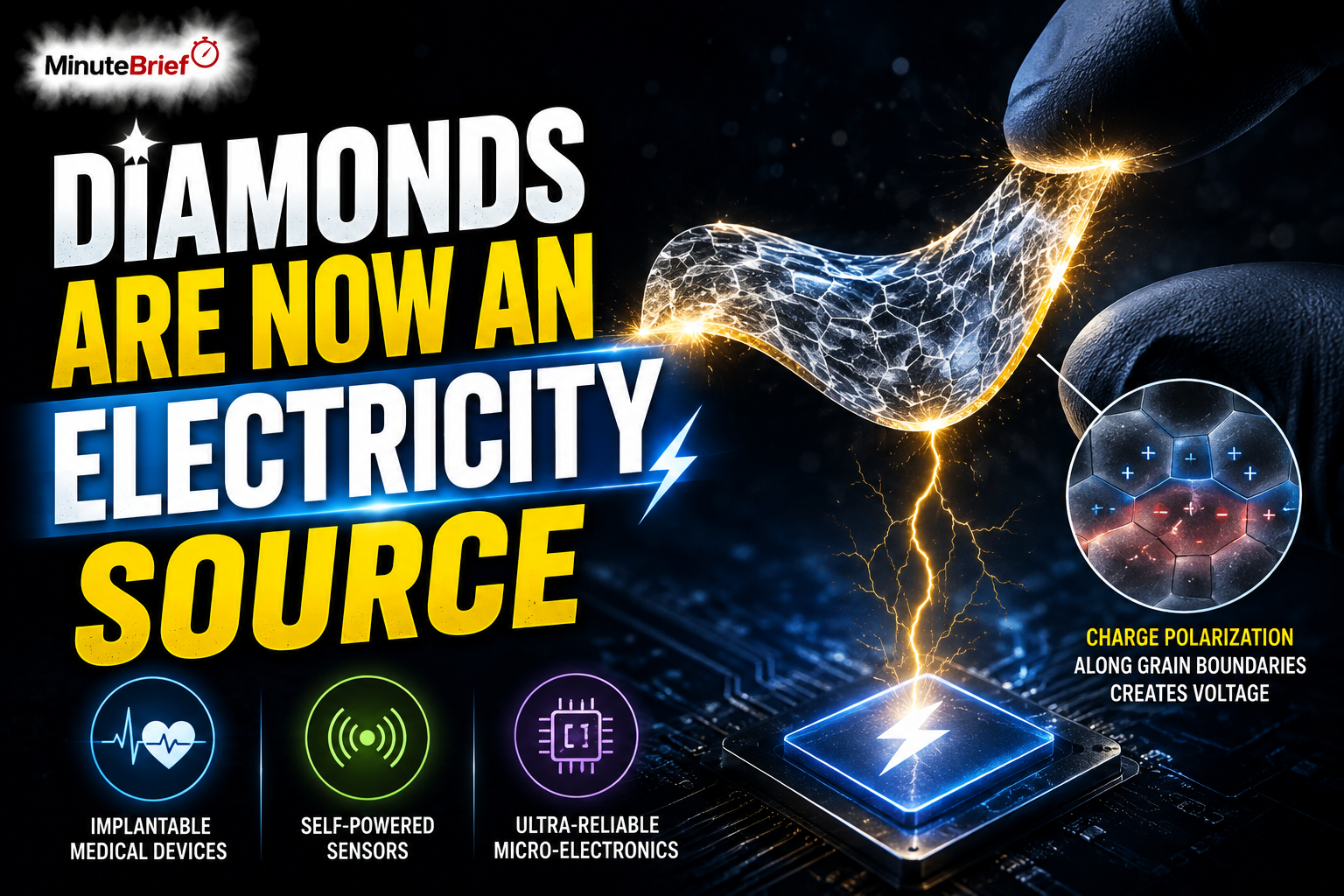
For over a century, scientists believed diamonds could not produce electricity when bent or squeezed. However, researchers at The University of Hong Kong have overturned this assumption, showing that flexible, ultrathin diamond membranes generate measurable voltage.
- Breaking the Rule: Non-piezoelectric materials like standard diamond do not generate an electrical charge under mechanical stress. Because of this, engineers have traditionally used diamond only as a passive structural support.
- Making Diamond Bend: Using an advanced edge exfoliation technique, the team created ultrathin polycrystalline diamond membranes. When flexed, these membranes produced consistent, repeatable piezoelectric voltage.
- How It Works: Computational tests revealed that bending creates charge polarization along the grain boundaries—the microscopic borders between individual diamond crystals—creating voltage between the surfaces.
- Future Potential: Because diamond is non-toxic, durable, and chemically stable, these flexible membranes could power implantable medical devices (like pacemakers), self-powered sensors, and ultra-reliable micro-electronics.
Source: Science Daily