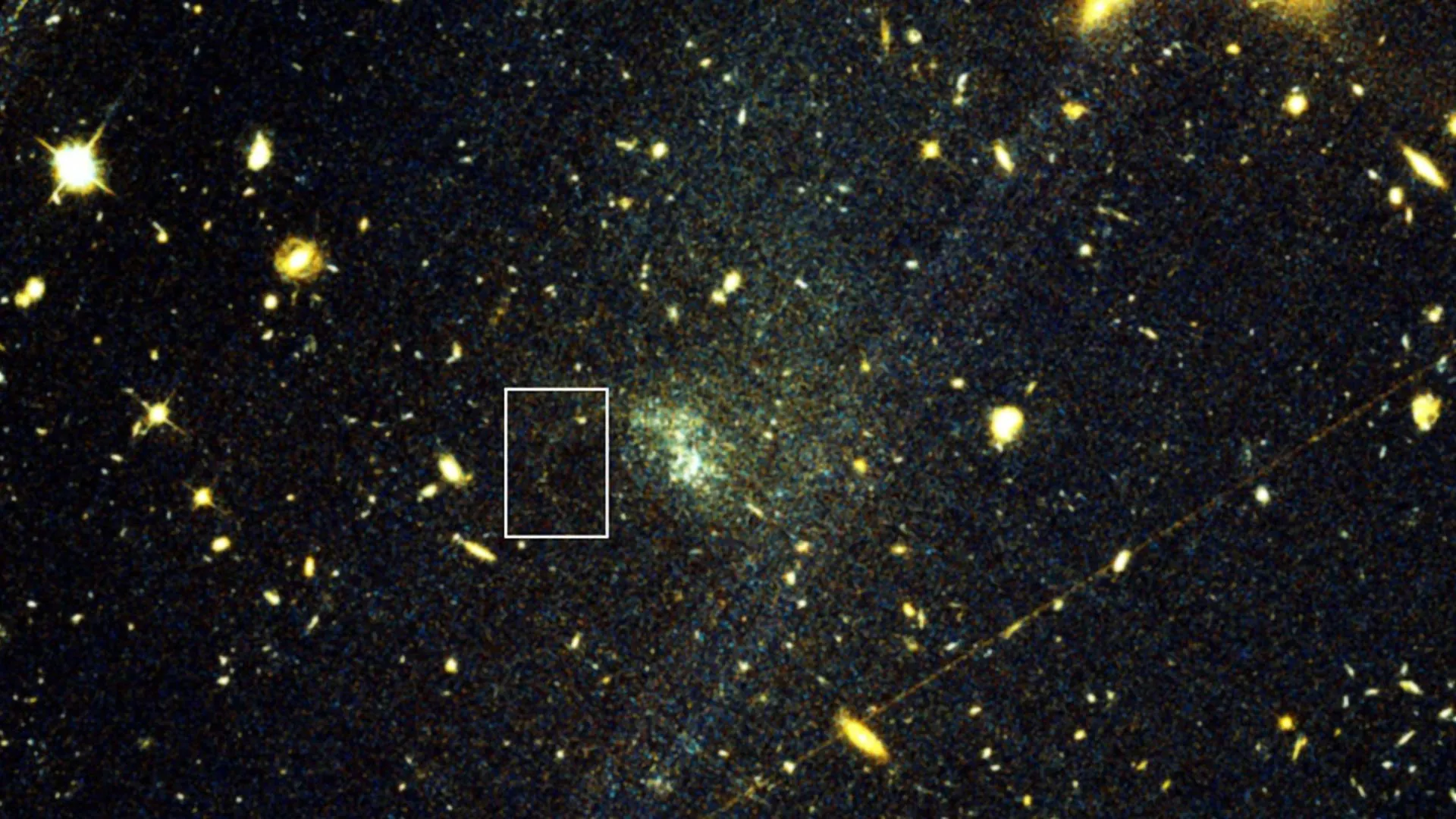
In a landmark discovery published in Nature, an international team of astronomers has identified a globular cluster stellar stream outside our home galaxy for the first time. The finding offers scientists a brand-new method to detect and map dark matter in distant regions of the cosmos.
What Is a Globular Cluster Stellar Stream?
A globular cluster stellar stream is a long, faint ribbon of stars pulled away from a dense star cluster by the gravitational force of a surrounding host galaxy—a process known as tidal stripping.
Because these delicate trails of stars react directly to gravity, they serve as natural "tracers" for a galaxy’s mass. By studying how these streams move and shape themselves, astronomers can map out invisible structures like dark matter, which makes up an estimated 80% to 85% of all matter in the universe.
Key Highlights of the Discovery
- First Outside the Milky Way: While stellar streams have been observed within our own galaxy, this marks the first time one has been detected in a distant galaxy.
- Ultra-Diffuse Target: The stream was spotted inside UGC9050-Dw1, an "ultra-diffuse galaxy" known for giving off very little light, making the detection particularly challenging.
- Confirming Dark Matter Profiles: The researchers used the stream to estimate the total mass and dark matter distribution of UGC9050-Dw1, confirming that it holds large amounts of dark matter as expected.
Why This Discovery Matters
Until now, using stellar streams to measure dark matter was a tool limited exclusively to the Milky Way. Demonstrating that this method works in distant, faint galaxies opens up entirely new avenues for cosmological research.
As next-generation observatories like the Euclid Space Telescope and the Nancy Grace Roman Space Telescope begin capturing clearer views of faint galactic structures, astronomers expect the number of known stellar streams to grow dramatically—bringing us one step closer to understanding the true nature of dark matter.