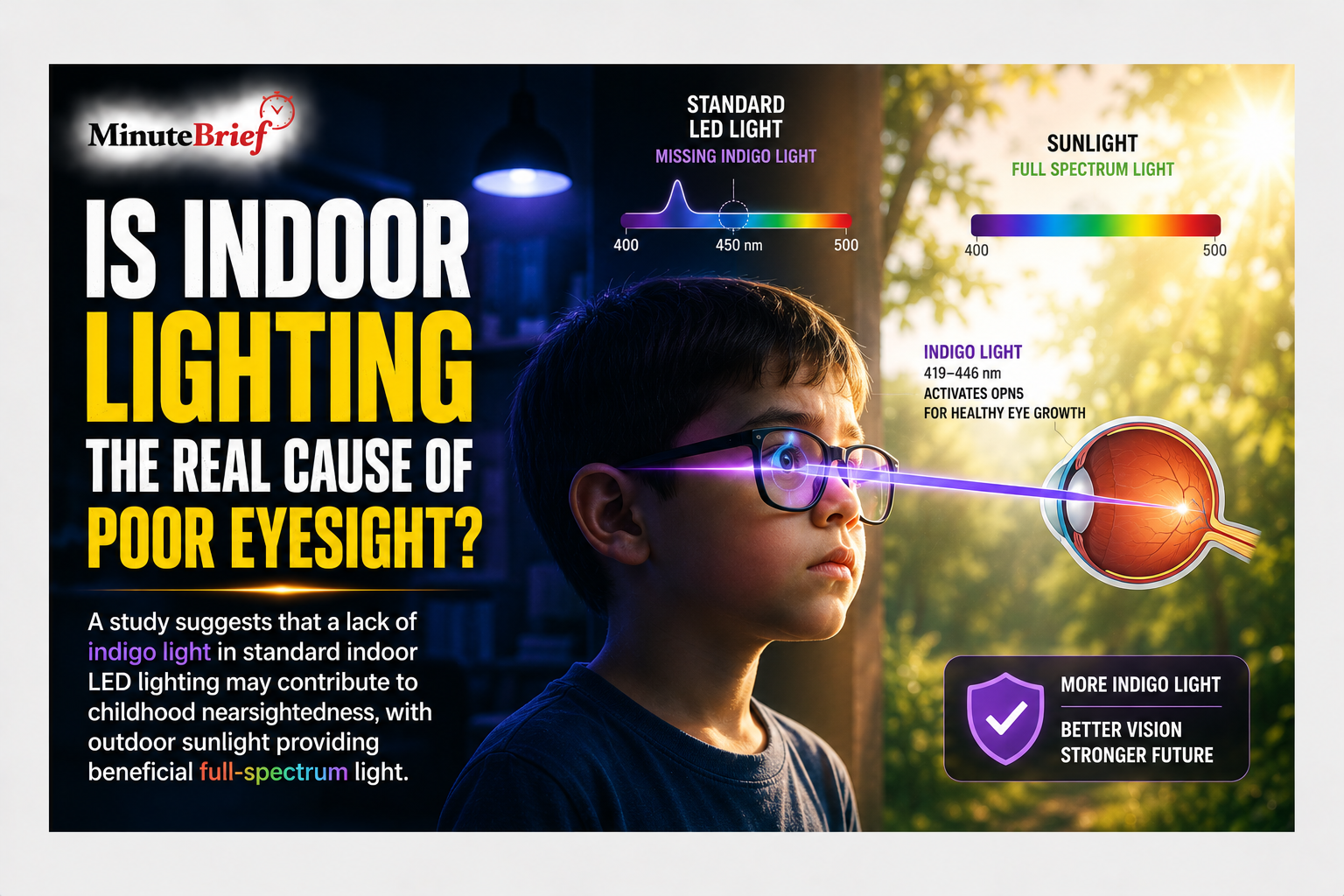
A missing color in standard indoor lighting could be key to preventing childhood nearsightedness.
A study in Cell Reports Medicine by Cincinnati Children’s Hospital and the University of Alabama at Birmingham shows that indigo light—abundant in sunlight but scarce in LED bulbs—completely prevented myopia in animal models.
The Missing Spectrum
Myopia occurs when the eye elongates, causing light to focus in front of the retina. Rates are skyrocketing, with predictions that half the world will be nearsighted by 2050.
- Sunlight: Offers full-spectrum light, including key non-visual wavelengths.
- Standard White LEDs: Peak around 450 nanometers and lack short-wavelength indigo light (419–446 nanometers).
- The Biological Receptor: Indigo light passes through the eye's lens to activate OPN5, a light sensor critical for healthy eye growth.
Next Steps for Indoor Spaces
While outdoor play remains ideal, shifting modern screen habits is tough. Researchers plan to test indigo-enriched lighting in daycares to see if passive upgrades to indoor light can protect children's vision while they play and learn inside.
Source: Science Daily