In Brief
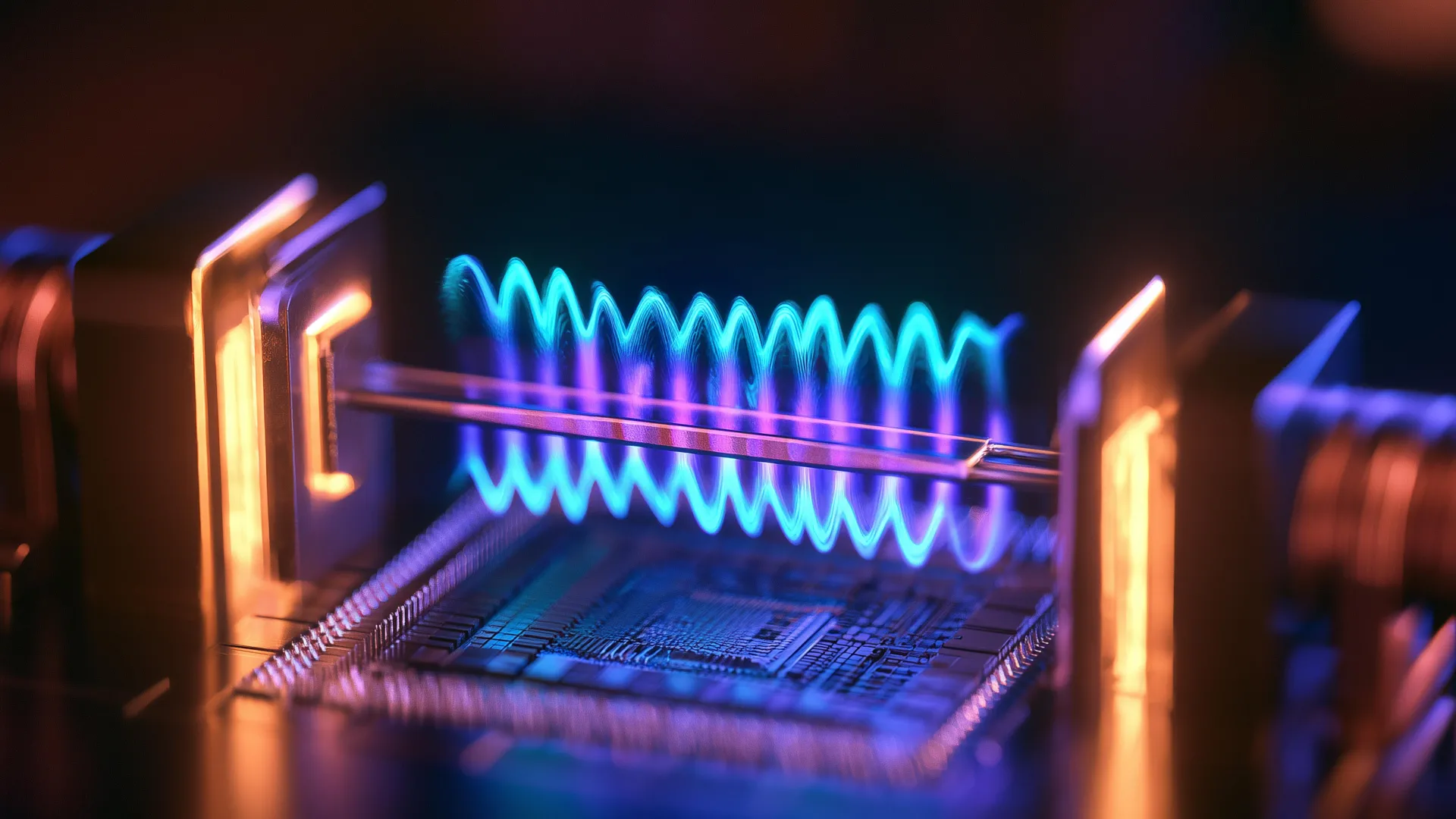
- Vibrating Memory: The quantum chip uses tiny mechanical resonators that store information in specific vibrational states, similar to vibrating guitar strings.
- Space-Efficient Design: Unlike bulky electromagnetic storage systems, mechanical resonators are compact and support multiple vibrational modes to hold more data simultaneously.
- Enhanced Stability: The vibrating architecture successfully keeps delicate quantum states stable for longer periods without rapid signal decay.
- Successful Stress Tests: The system passed critical computational benchmarks, including the quantum Fourier transform and period-finding algorithms.
Rethinking Quantum Architecture
For years, the development of scalable quantum computers has been bottlenecked by the bulky nature of electromagnetic memory systems paired with superconducting qubits. While precise, these traditional components demand significant physical space, creating steep hurdles for building market-ready quantum hardware.
To solve this, researchers at ETH Zurich designed an architecture that cleanly separates information processing from working memory. In this setup, microscopic components called mechanical resonators vibrate to store data. When a qubit needs to perform a calculation, it retrieves the information from the vibrational state, modifies it, and stores it back.
Passing Major Computational Milestones
To prove that mechanical resonators can act as genuine computational resources rather than passive storage units, the team tested the chip on core quantum algorithms:
- Quantum Fourier Transform: A foundational mathematical procedure required across numerous quantum algorithms.
- Period-Finding: Demonstrated the system's ability to precisely control, store, and coherently link multiple delicate quantum states simultaneously.
Next Steps
While further engineering will be required to scale the technology into larger multi-qubit processors, this proof-of-concept establishes vibrating mechanical memory as a highly viable, compact alternative to conventional electromagnetic approaches.