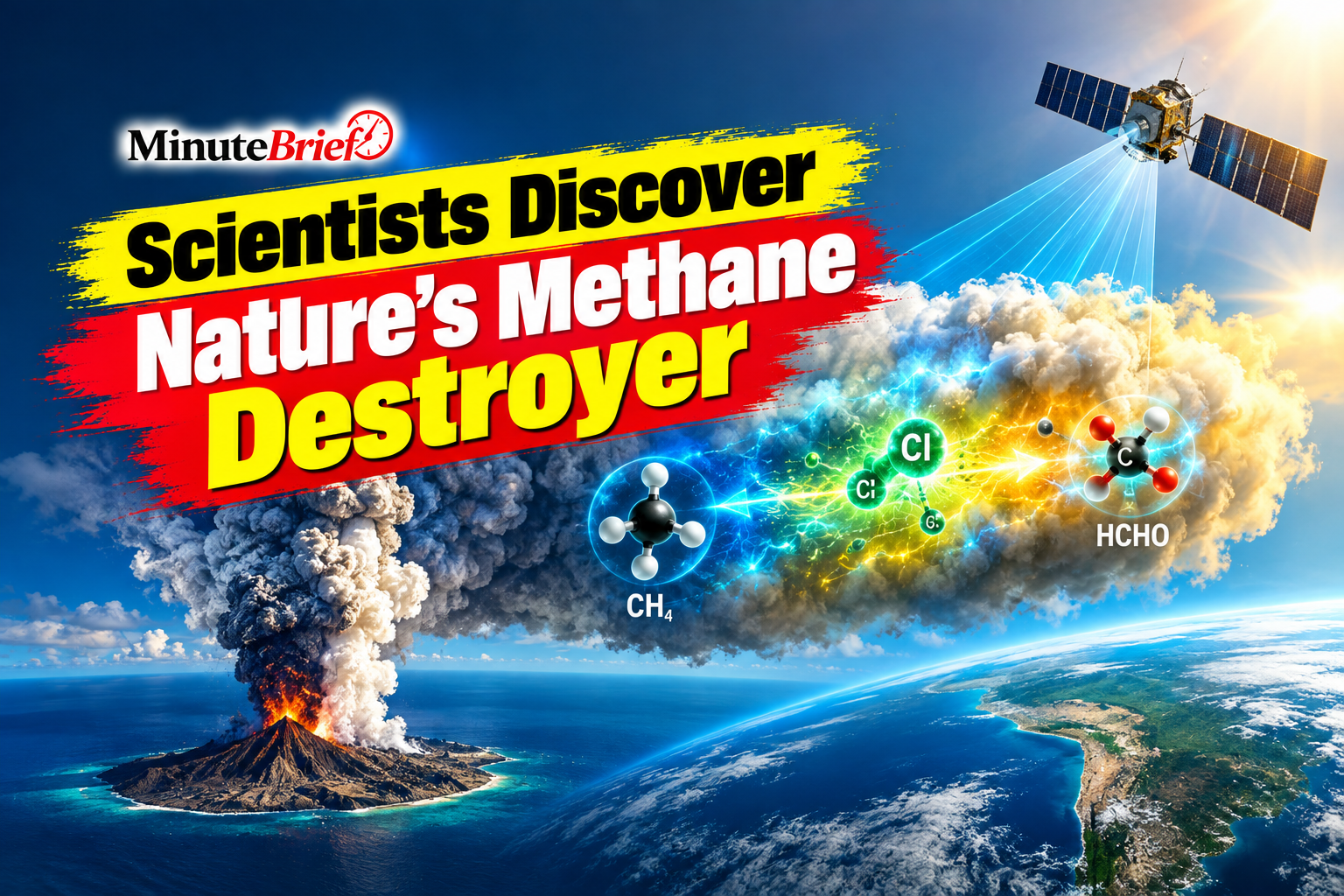
When the Hunga Tonga–Hunga Ha'apai underwater volcano erupted in January 2022, it was one of the most powerful explosions in modern history. Now, scientists have uncovered an unexpected outcome: the massive volcanic cloud actively broke down the methane pollution generated during the eruption.
According to a study published in Nature Communications by researchers at the University of Copenhagen, this natural mechanism offers a dramatic real-world demonstration of atmospheric self-cleaning.
How the Discovery Was Made
Using satellite observations from the European Space Agency's Sentinel-5P satellite, researchers tracked the volcanic plume as it traveled toward South America. They detected record-high concentrations of formaldehyde—a short-lived chemical byproduct created when methane breaks apart in the atmosphere.
Because formaldehyde survives for only a few hours, its continuous presence over a 10-day period proved that methane was being destroyed constantly throughout the cloud.
The Chemistry Behind the Clean-Up
The rapid breakdown resulted from an unusual mix of volcanic material, ocean water, and sunlight:
- Underwater Eruption: Because the blast occurred underwater, it shot vast quantities of salty sea water alongside volcanic ash straight into the stratosphere.
- Chlorine Release: Sunlight striking this unique aerosol mixture released highly reactive chlorine atoms.
- Methane Removal: The airborne chlorine attacked methane molecules in the plume, destroying roughly 900 megagrams of methane per day—an amount equivalent to the daily emissions of two million cows.
Why It Matters for Climate Action
Methane is a potent greenhouse gas, trapping about 80 times more heat than carbon dioxide over a 20-year period. However, unlike carbon dioxide, which lingers for centuries, methane breaks down in roughly a decade.
Because of its shorter lifespan, rapidly accelerating methane removal acts as a critical "emergency brake" on global warming. Proving that satellite technology can measure real-time methane destruction in space could help researchers design, test, and verify future climate intervention strategies modeled after nature.