In Brief:
- A segment of a SpaceX Falcon 9 rocket crashed into the Moon.
- The upper stage had been drifting in space for over a year following a lunar payload mission.
- The event marks a rare instance of accidental artificial impact on the lunar surface.
- Space agencies monitor space debris to study lunar surface dynamics and plan safer missions.
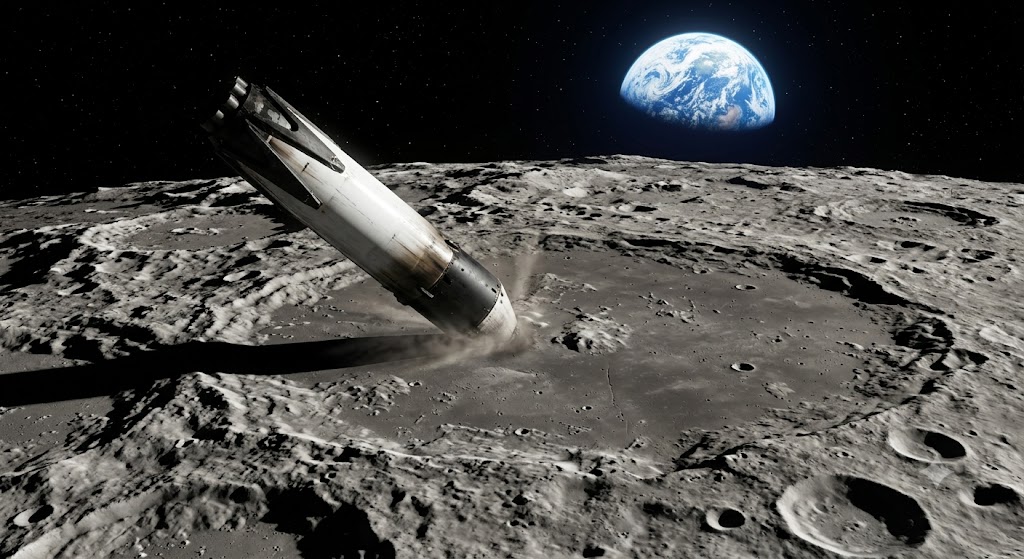
A discarded second-stage segment of a SpaceX Falcon 9 rocket is believed to have crashed into the Moon after drifting in space for over a year. The crash was expected to take place at approximately 2:35 a.m. ET (06:35 GMT), with the 4-metric-tonne (4,000 kg) piece travelling at an estimated 5,400 mph (8,690 km/h) at impact.
Astronomers targeted the collision site near the Einstein Crater, located on the Moon’s western limb—a region often difficult to observe directly from Earth. The high-speed impact was expected to kick up a plume of lunar dust illuminated by sunlight, though experts noted it would be nearly impossible to spot with the naked eye from Earth.
Scientists are currently awaiting visual or telemetry confirmation of the event, as transmitting data and orbital images back to Earth takes time.