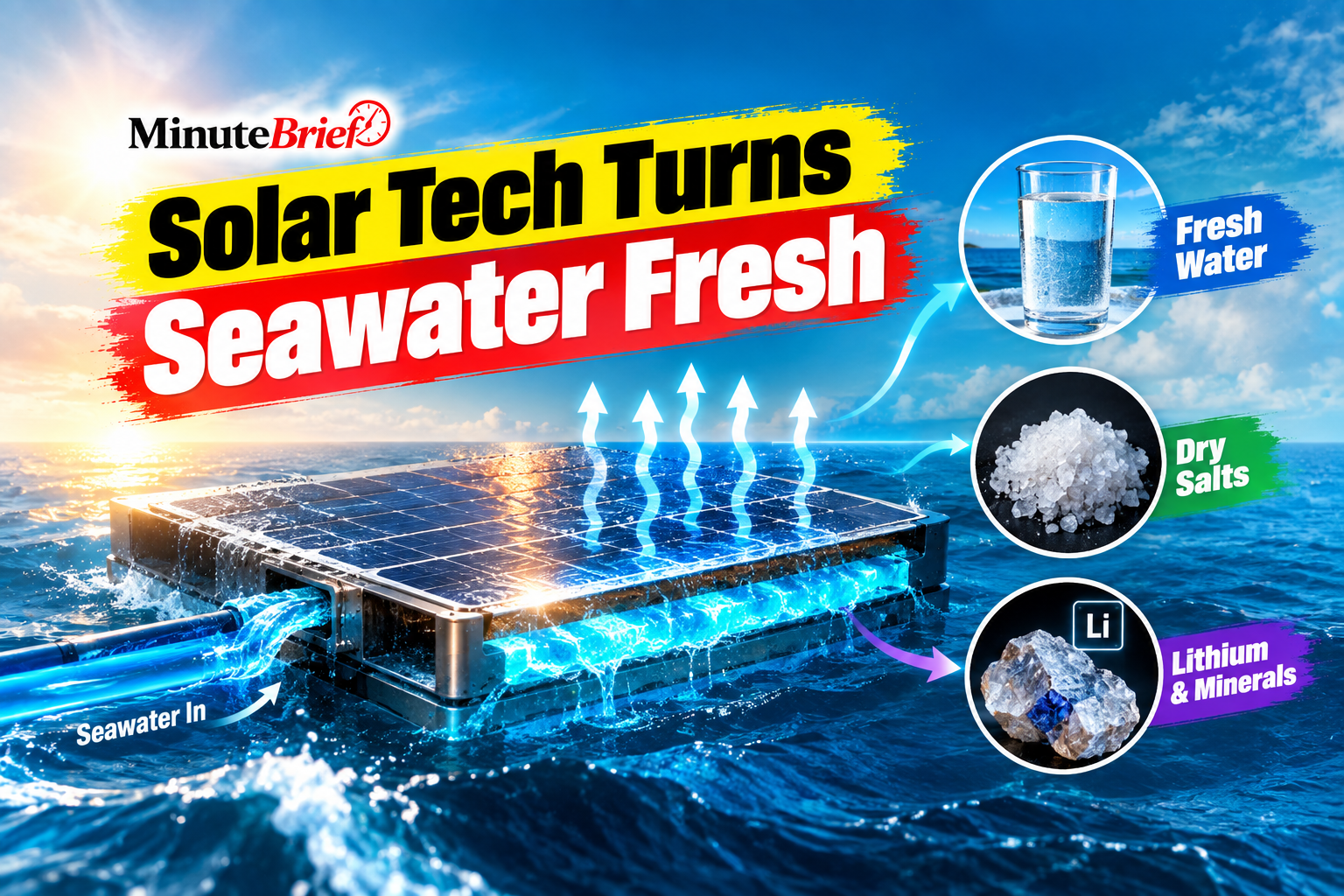
Researchers at the University of Rochester have developed a solar-powered desalination system that transforms seawater into fresh drinking water while eliminating toxic liquid brine waste and harvesting valuable battery-grade minerals like lithium.
The Innovation: Laser-Treated Black Metal
Led by optics and physics professor Chunlei Guo, the team used ultrafast femtosecond lasers to etch microscopic structures onto metal panels.
- Maximum Solar Heat: The laser treatment turns the metal jet-black, allowing it to absorb nearly all incoming sunlight to heat water quickly.
- Superwicking Action: Instead of letting water bead up, the surface forces seawater to spread into an ultra-thin layer across the panel, accelerating solar evaporation.
Solving the Salt Scaling Problem
Evaporating real seawater usually leaves behind dense, stubborn mineral scale—much like the buildup inside a kettle—that quickly clogs desalination equipment.
To overcome this, the researchers engineered microscopic grooves that exploit the "coffee ring effect"—the physical phenomenon that pushes drying particles to the outer edge of a liquid spill. As seawater evaporates under the sun, the panel continuously pushes crystallizing salt particles away from the heated active zone toward the cooler edges. This keeps the active area clean and running efficiently without requiring chemical pre-treatments.
Zero Liquid Waste and Mineral Mining
Unlike conventional desalination plants that discharge millions of gallons of oxygen-depleting liquid brine back into the ocean, this system extracts nearly 100% of dissolved salts as dry solids.
- Lithium Extraction: By embedding hydrogen titanate nanoparticles into the panel's micro-grooves, the team recovered up to 50% of the lithium present in saltwater samples.
- Dual Benefits: The collected solid minerals can be refined for commercial use, offering a cleaner way to source battery materials for electric vehicles while tackling global water scarcity.