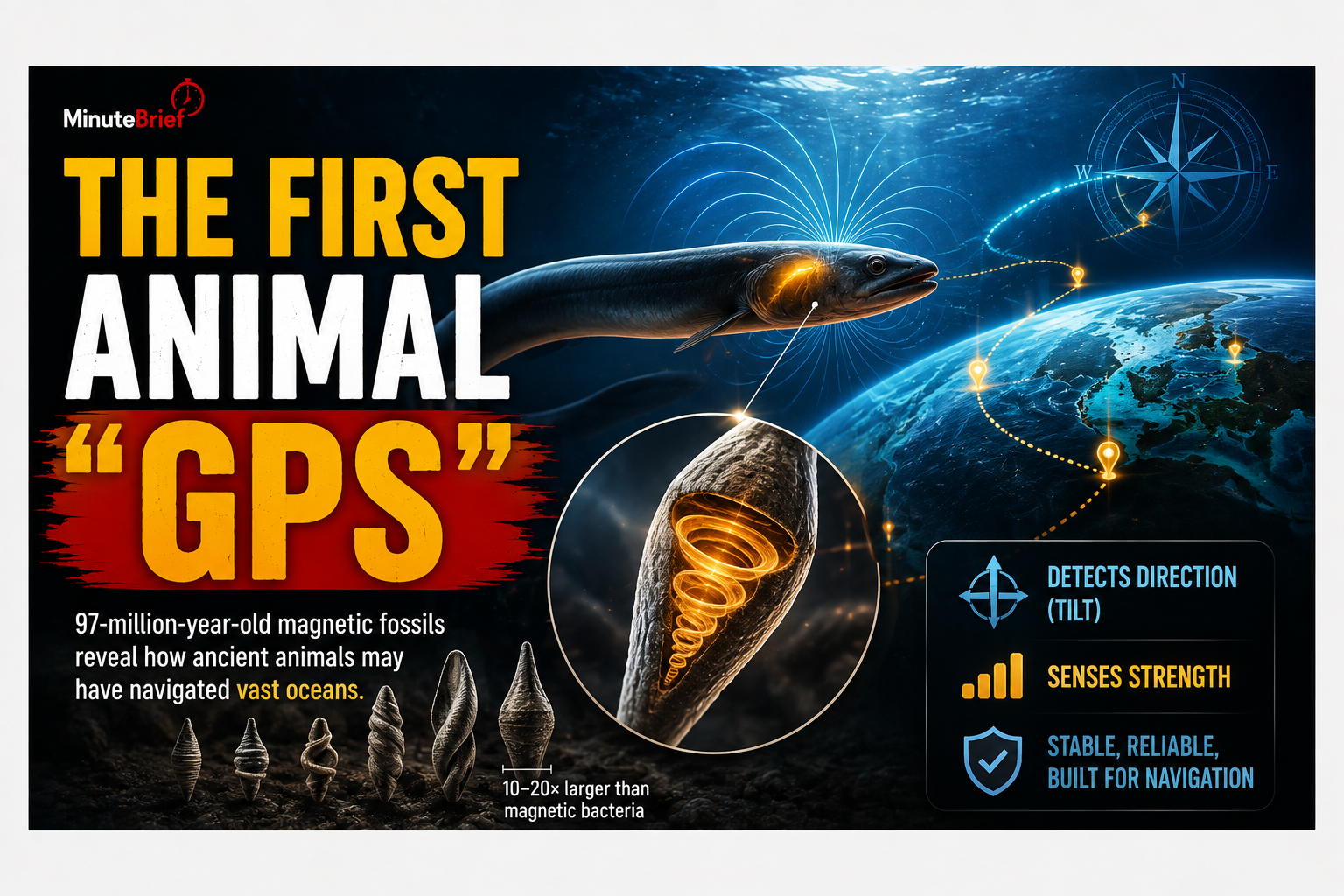
How do migratory animals navigate thousands of kilometers across vast oceans without getting lost? A breakthrough study led by researchers at the University of Cambridge and Helmholtz Zentrum Berlin has uncovered 97-million-year-old magnetic fossils that may be the earliest known evidence of an internal biological "GPS" system.
What Are Magnetofossils?
Discovered in ancient North Atlantic seafloor sediments, these microscopic structures—known as magnetofossils—come in shapes like spearheads, spindles, and needles.
- Microscopic Scale: At just 10 to 20 times larger than magnetic particles found in bacteria, each fossil is still far smaller than a single grain of sand.
- A Long-Standing Mystery: While scientists knew these tiny structures were biological in origin, their exact function remained uncertain, with early theories guessing they served as protective spines.
A 3D View Into Ancient Navigation
Using advanced X-ray imaging at the Diamond Light Source in Oxford, researchers produced the first 3D magnetic vector tomography images of the fossils' internal structures.
The analysis revealed a complex, tornado-shaped "vortex" magnetic pattern that is exceptionally stable and uniquely suited for navigation:
- Dual-Axis Detection: The vortex structure allows an animal to detect both the direction (tilt) and strength of Earth’s magnetic field.
- Full Coordinates: By measuring tilt, the animal could determine its latitude; by sensing strength, it could gauge changes in longitude.
- Disturbance Resistance: The stable magnetic configuration protects against environmental noise, ensuring reliable tracking over long distances.
"If nature developed a GPS, a particle that can be relied upon to navigate thousands of kilometers across the ocean, then it would be something like this."
— Professor Rich Harrison, Lead Co-Author, University of Cambridge
Who Created the Fossils?
While the precise species that created these magnetofossils remains unknown, researchers know what kind of animal to search for: a widespread, migratory ocean creature.
One prime candidate is the ancient eel:
- Eels first evolved approximately 100 million years ago.
- Modern eels undertake massive migrations—traveling thousands of kilometers from freshwater rivers to spawn in the Sargasso Sea using magnetic sensing.
- Though magnetite particles have been found in modern eels, imaging them inside living tissues remains difficult due to their microscopic size.
Evolutionary Significance
Understanding these ancient fossils helps bridge a major evolutionary gap. It reveals how basic magnetic orientation—used by simple aquatic bacteria to navigate up and down in water columns—evolved into a highly specialized, map-like navigation system that allowed animals to traverse entire oceans.