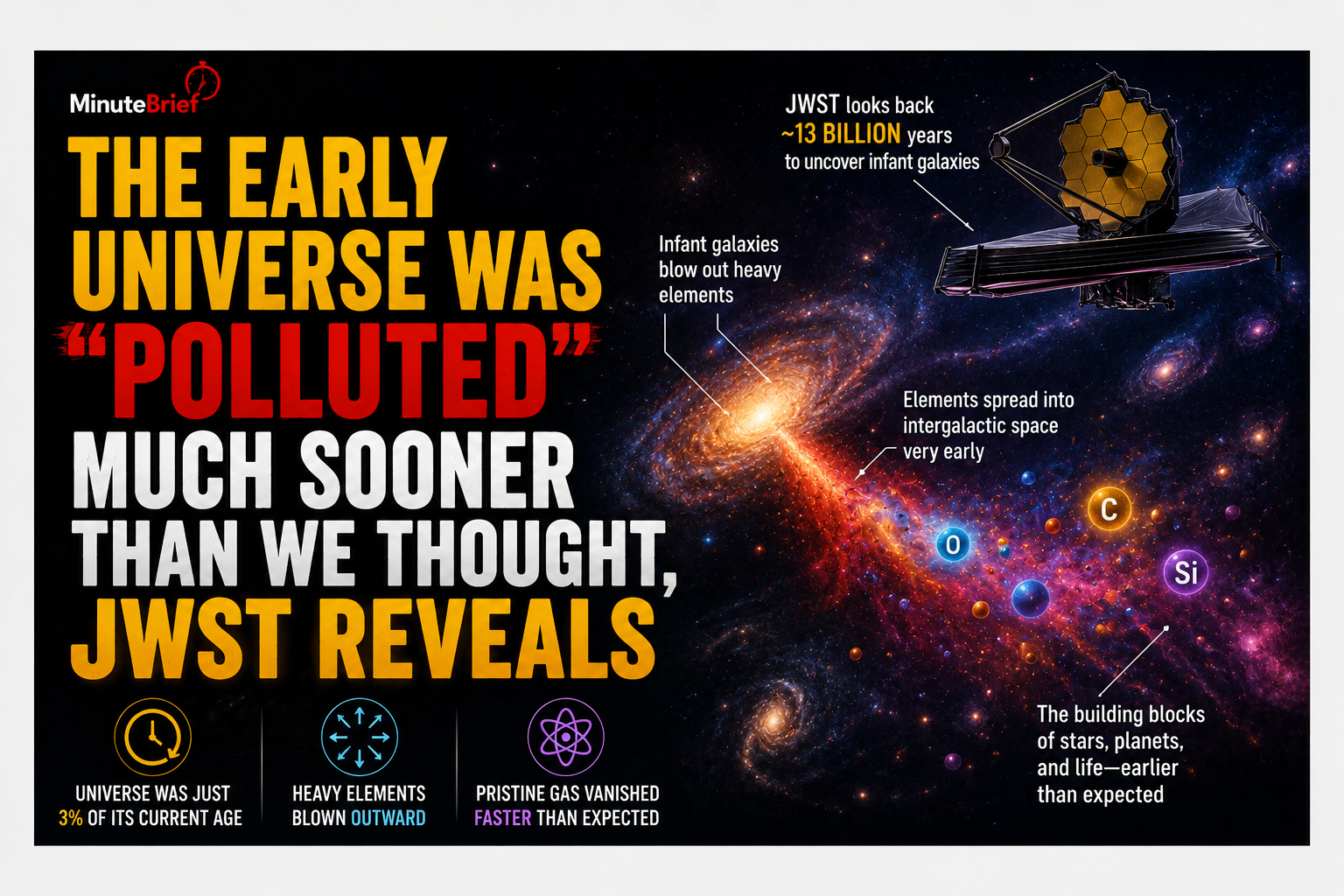
When the universe was in its infancy—just 500 million years after the Big Bang—astronomers expected space to be almost entirely "pristine," composed almost exclusively of hydrogen and helium. However, new findings from NASA’s James Webb Space Telescope (JWST) reveal that infant galaxies were already manufacturing and scattering complex elements like carbon and oxygen into intergalactic space much earlier than anyone anticipated.
Key Findings at a Glance
A study led by researchers at the University of Arizona and published in Nature Astronomy examined three ultra-distant galaxies whose light traveled for over 13 billion years to reach us:
- Early Chemical Pollution: Galaxies were actively expelling heavier elements into surrounding space when the universe was at just 3% of its current age.
- Driven Outward: Spectral analysis showed the outflowing gas was "blueshifted," meaning heavy elements were being actively blown away from galaxies and into the broader intergalactic medium.
- Surprisingly Mature: The chemical signatures surrounding these infant galaxies looked remarkably similar to those seen around mature galaxies billions of years later.
How Stars Created the Periodic Table
Immediately after the Big Bang, the cosmos contained little more than hydrogen and helium. As gravity pulled gas clouds together, the first generation of stars ignited. Deep within these stars, intense nuclear fusion produced heavier elements—such as carbon, oxygen, and silicon.
When those stars reached the end of their lifecycles and exploded as supernovae, they released those elements into space. This material eventually laid the foundation for future generations of stars, rocky planets, and eventually, the chemistry needed for life.
The "Drop of Food Dye" Effect
Astronomers refer to the exchange of material between galaxies and their surroundings as baryon cycling. Rather than existing as isolated islands, early galaxies were dynamic, interacting ecosystems.
To visualize how fast this enrichment happened, lead author Yongda Zhu offers a simple analogy:
"Think of these elements, which originated from the galaxies' stars, as food dye dropped into a cup of water. The color begins to spread through the water, and in a similar fashion, these heavy elements from early galaxies began to escape into space and 'enrich' their surroundings."
Solving the Mystery of Population III Stars
This rapid chemical enrichment may also solve a long-standing astronomical puzzle involving Population III stars—hypothetical, pristine stars made purely of hydrogen and helium that formed before any heavy elements existed.
Because galaxies began polluting their surrounding space so early, pristine gas likely vanished very quickly.
"If you start out with pure vanilla ice cream but start mixing in sprinkles soon after, it won't be long until you can no longer find any pristine, plain, vanilla ice cream," Zhu explained.
As a result, true Population III stars may have been short-lived and exceedingly rare, explaining why astronomers have struggled to detect them directly.