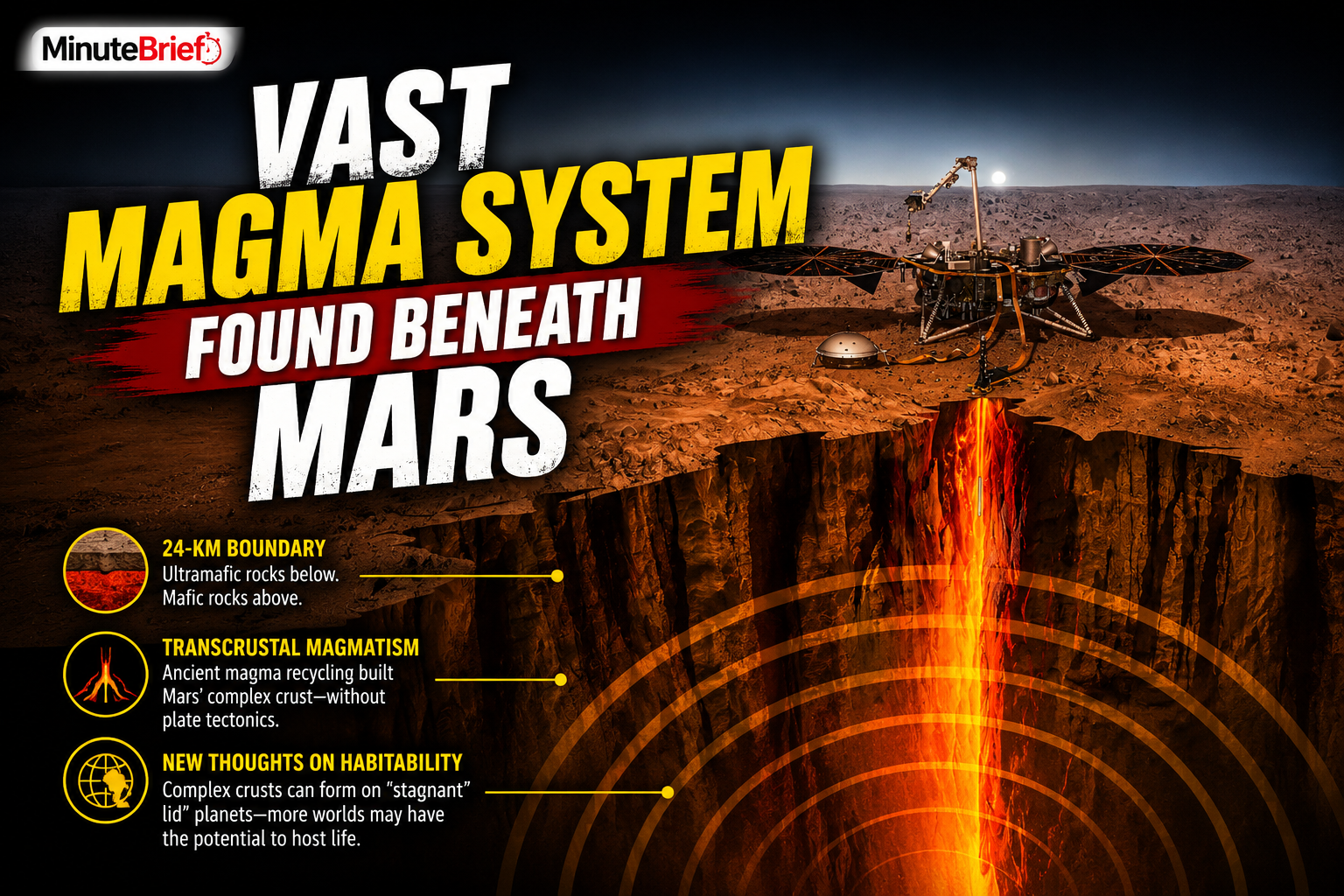
Mars has long been viewed as geologically quiet, lacking Earth’s moving tectonic plates. However, a study in Nature Astronomy reveals that Mars harbors an unexpectedly complex geological interior, reshaping how scientists view planetary evolution and potential habitability.
- The 24-Km Boundary: Analyzing seismic data from NASA’s InSight lander, Oxford researchers mapped a subterranean boundary 24 km down. Below this line lie iron- and magnesium-rich ultramafic rocks; above it, silica-rich mafic rocks.
- Transcrustal Magmatism: Instead of needing plate tectonics, ancient Mars achieved crustal complexity through internal recycling. Massive magma pools cooled slowly, letting heavy crystals sink while lighter, silica-rich liquid rose toward the surface across hundreds or thousands of kilometers.
- New Thoughts on Habitability: Plate tectonics was long thought necessary to recycle planetary material, regulate climate, and sustain conditions for life. This discovery proves complex crustal development can happen on "stagnant lid" planets, suggesting far more worlds in the universe might have the potential to host life.