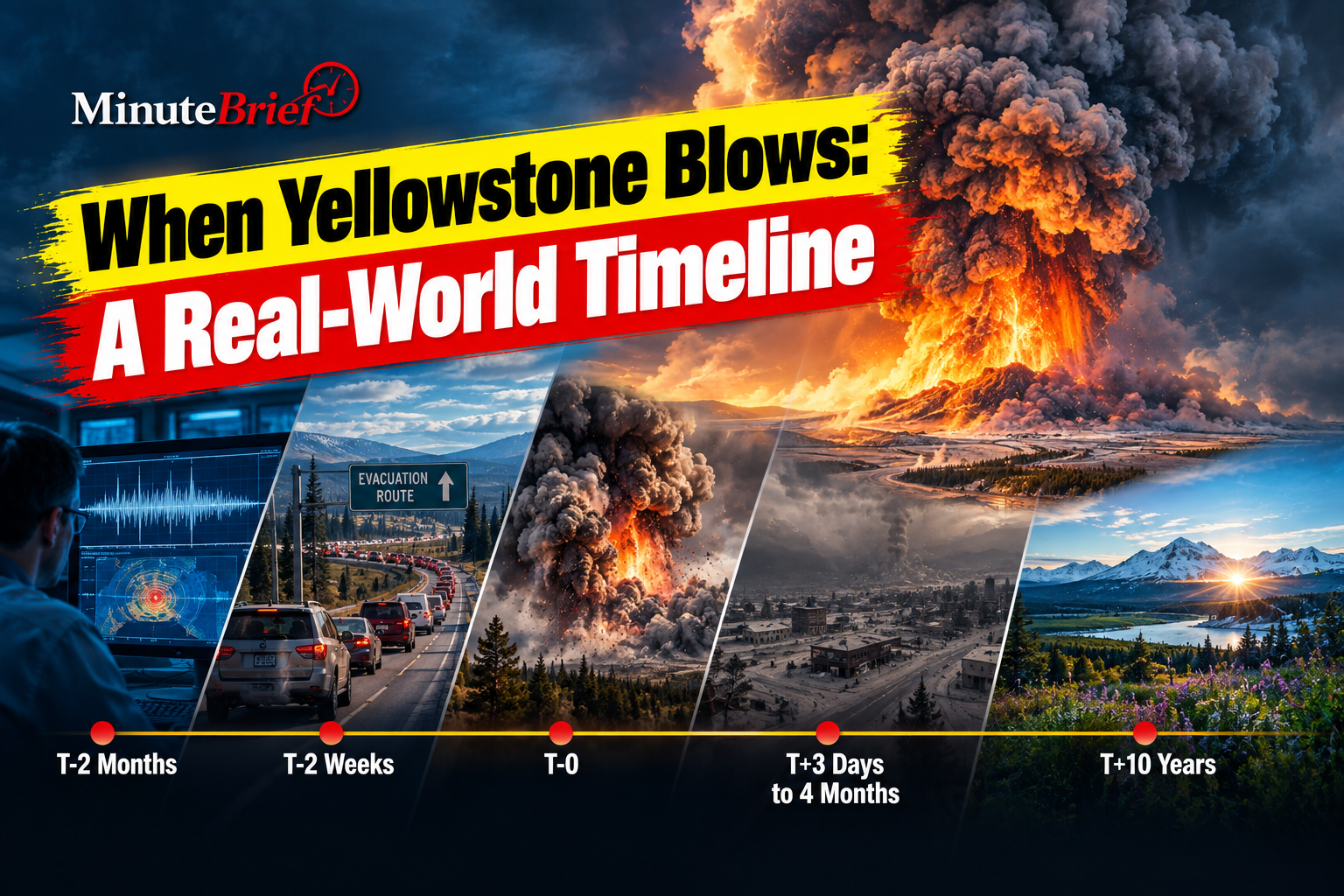
While pop culture depicts Yellowstone as a sleeping giant that could instantly obliterate North America without warning, scientists say a real-world eruption wouldn't come out of nowhere. Instead, it would unfold over months, offering clear warning signs long before any lava or ash hits the surface.
Here is how a worst-case Yellowstone super-eruption might actually play out.
T-2 Months: The First Warning Signs
Deep beneath the Yellowstone caldera, sensitive monitoring instruments begin detecting unusual activity:
- Migrating Earthquakes: Seismometers register small earthquake clusters moving progressively upward toward the surface.
- Surface Distortion: GPS stations show the ground above the swarm accelerating upward, driven by rising magma and superheated fluids.
- Erratic Geysers: Landmarks like Old Faithful erupt on unpredictable schedules, while surrounding hot springs emit elevated carbon dioxide and sulfurous gases.
T-2 Weeks: Mass Evacuations and Panic
As earthquakes intensify and the ground warps by centimeters a day, geologists raise the volcano alert level:
- Exclusion Zones: Authorities establish a 100-kilometer evacuation radius, displacing roughly 200,000 residents and tourists.
- Airspace & Logistics: Aviation threat codes are raised, rerouting commercial flights, while emergency management agencies scramble to arrange shelter, food, and transport.
T-0: The Blast Begins
The eruption starts not with the entire continent blowing up, but with trapped steam triggering violent explosions that shatter rock and send superheated mud into the air. Within hours, gas-rich magma breaks through the surface, escalating into a massive VEI 8 super-eruption:
- Eruption Plumes: A vast column of ash shoots 30 to 50 kilometers into the stratosphere, visible hundreds of miles away.
- Pyroclastic Flows: Superheated currents of rock and gas rush outward at hundreds of miles per hour, destroying everything in their path.
- Ash Blanket: Prevailing winds carry thick ash clouds across the country, plunging neighboring regions into darkness.
T+3 Days to 4 Months: Infrastructure Collapse
In the weeks following, the main threat becomes widespread infrastructure failure across North America:
- Power & Water Outages: Damp ash short-circuits electrical grids, shutting down water pumps, sanitation systems, and cell towers.
- Supply Chain Breakdown: Thick ash renders roads impassable, grounds air traffic, and buries Midwestern farmland, threatening global food supply chains.
- Health Risks: Inhaled volcanic ash causes severe respiratory issues, placing immense strain on healthcare networks.
T+10 Years: A Changed World
A decade later, humanity enters a long-term phase of recovery:
- Volcanic Cooling: Sulfur dioxide trapped in the stratosphere reflects sunlight, lowering global temperatures by about 1.5°C and altering weather patterns.
- Agricultural Adaptation: Communities shift toward resilient crops, greenhouses, and localized farming to adapt to shorter growing seasons.
- Ecological Rebirth: Plant life slowly returns to the ash-covered landscapes around Yellowstone, laying the foundation for long-term recovery.