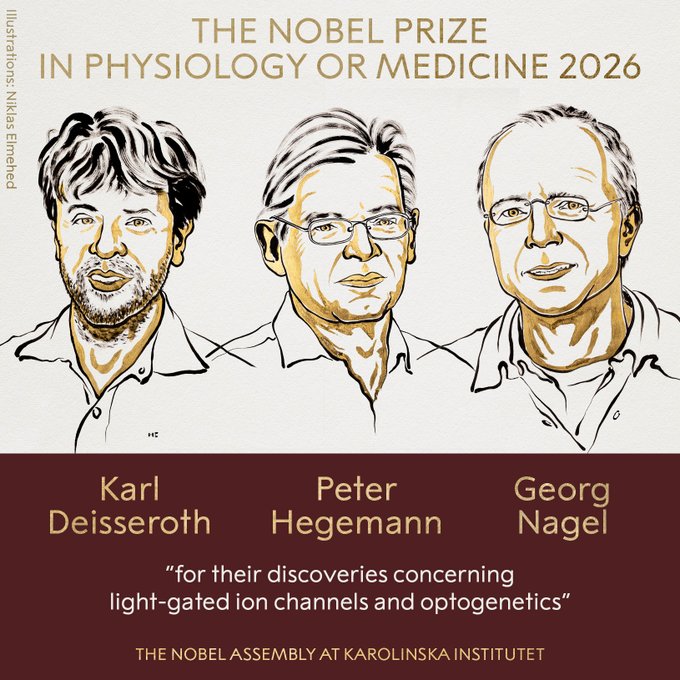
The 2026 Nobel Prize in Physiology or Medicine has been awarded jointly to Karl Deisseroth, Peter Hegemann, and Georg Nagel for their landmark discoveries concerning light-gated ion channels and the development of optogenetics—a groundbreaking technique that enables scientists to control specific brain cells using light.
The Breakthrough: Controlling Brain Cells with Light
Understanding how individual brain circuits shape thoughts, memories, emotions, and behaviors has long been one of neuroscience's greatest challenges. Optogenetics revolutionized the field by giving researchers a precise "light switch" to activate or silence target neurons in living tissue.
- Discovering the Light Switch: In the 1990s and early 2000s, biophysicists Peter Hegemann and Georg Nagel identified and characterized channelrhodopsins—light-sensitive ion channels found in green algae. These proteins allow microscopic organisms to sense light and move toward it.
- Transforming Neuroscience: Neuroscientist and psychiatrist Karl Deisseroth at Stanford University realized these algal proteins could be engineered into mammalian brain cells. By inserting the genes for channelrhodopsins into specific neurons, his team demonstrated that flashing light through fiber-optic cables could instantly switch targeted nerve cells on or off.
Why Optogenetics Matters
Before optogenetics, methods used to stimulate the brain (such as electrical currents or drugs) were imprecise, affecting surrounding tissues or acting too slowly. Optogenetics provides unprecedented cell-type precision and millisecond-level time resolution.
This technology has allowed scientists around the world to map complex neural circuits, deepening our understanding of:
- Neurological and Psychiatric Disorders: Insights into depression, schizophrenia, autism, Parkinson's disease, and addiction.
- Fundamental Brain Functions: How neural networks process sensory information, form memories, and trigger motor actions.
By turning microscopic light-sensing proteins from algae into powerful neuroscientific tools, Deisseroth, Hegemann, and Nagel fundamentally transformed how we study the brain, paving the way for targeted treatments for complex brain conditions.