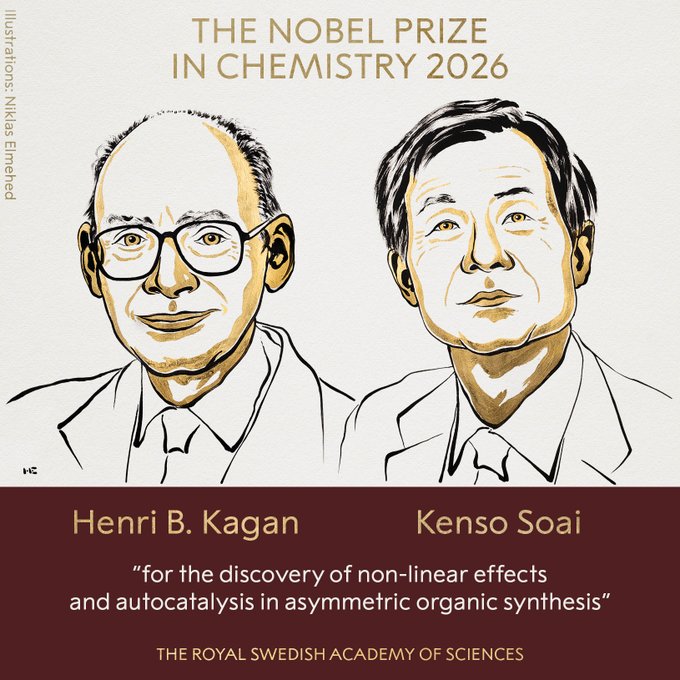
Every year, the Nobel Prize honors scientific discoveries that change how we understand the world. The 2026 Nobel Prize in Chemistry was awarded to Henri B. Kagan and Kensō Soai for their ground-breaking work on asymmetric organic synthesis—specifically, their discoveries of non-linear effects and chemical autocatalysis.
While those terms might sound intimidating, the underlying scientific puzzle is one that has intrigued researchers for over a century: homochirality, or the mystery of "handedness" in nature.
The Mystery of Left- and Right-Handed Molecules
Many biological molecules exist in two mirror-image forms, much like your left and right hands. They contain the exact same atoms connected in the exact same sequence, yet one form cannot be perfectly superimposed on the other. This property is known as chirality.
In a standard chemistry lab, producing these molecules typically yields an equal 50/50 mixture of both "hands." However, natural biology operates differently:
- Selective Life: The proteins in your cells rely almost exclusively on "left-handed" amino acids, while DNA and RNA backbones rely on "right-handed" sugars.
- Real-World Impact: In pharmaceuticals, handedness matters tremendously. One enantiomer (mirror image) of a drug might cure an illness, while its twin could be completely ineffective or even harmful.
For a long time, scientists struggled to understand how biological systems could consistently select and amplify just one mirror image from an unbiased starting point.
The Breakthroughs
The 2026 laureates provided key experimental answers to how chemical reactions can amplify one handedness over another.
1. Henri B. Kagan: Non-Linear Effects
Previously, chemists assumed that to produce a highly pure "handed" molecule, you needed an equally pure chiral catalyst to drive the reaction. In 1986, Henri B. Kagan (Université Paris-Sud) proved this assumption wrong. He discovered non-linear effects, showing that even a slightly impure or low-quality chiral catalyst can produce a near-pure single-handed product. This discovery drastically lowered the cost and complexity of synthesizing pure compounds for medicine.
2. Kensō Soai: Asymmetric Autocatalysis
Kensō Soai (Tokyo University of Science) took this concept a step further by discovering asymmetric autocatalysis (often called the Soai reaction). In this reaction, the chiral product acts as its own catalyst. As the reaction proceeds, it continuously copies itself, rapidly amplifying even the tiniest initial imbalance until only one mirror-image molecule dominates the entire solution.
Why It Matters
Together, Kagan and Soai solved a fundamental puzzle about how life on Earth could have originated from simple, symmetrical chemical beginnings.
Beyond explaining the origins of biological asymmetry, their work serves as a foundational pillar for modern organic chemistry. It allows chemical engineers and pharmaceutical manufacturers to precisely control molecular chirality, leading to safer drugs, effective agricultural chemicals, and advanced materials.