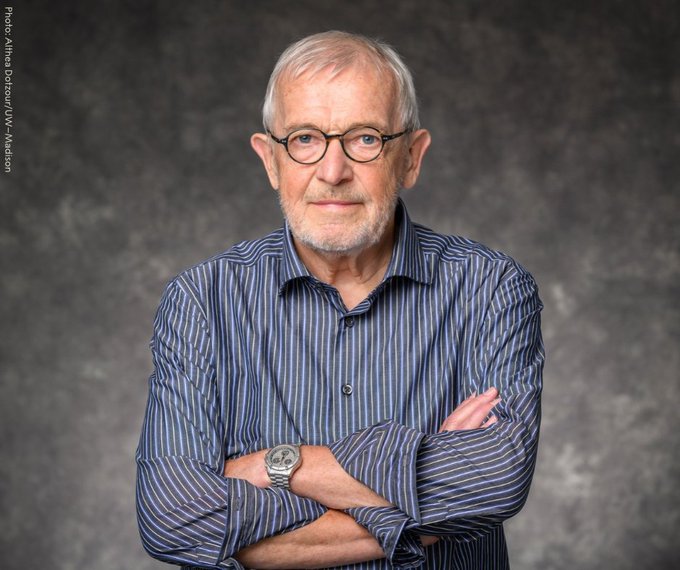
Belgian-American physicist Francis Halzen has been awarded the 2026 Nobel Prize in Physics for his pioneering contributions to the creation of the IceCube Neutrino Observatory and the historic discovery of high-energy neutrinos originating from deep space.
Halzen, a professor at the University of Wisconsin–Madison, was named the sole recipient of this year’s award, which carries a prize of 12 million Swedish kronor.
The Challenge: Detecting "Ghost Particles"
Neutrinos are fundamental subatomic particles often referred to as "ghost particles" because they have almost no mass, travel at nearly the speed of light, and pass through solid matter—including the entire Earth—without interacting with it. Because they travel in straight lines uninterrupted by magnetic fields or dense matter, neutrinos carry pristine information about extreme cosmic events, such as supernovae, gamma-ray bursts, and supermassive black holes.
However, their elusive nature makes them notoriously difficult to catch.
A Bold Solution Beneath the Antarctic Ice
To capture these faint cosmic signals, Francis Halzen proposed a radical idea: transform a massive block of pristine Antarctic glacial ice into a giant particle detector.
This vision led to the construction of the IceCube Neutrino Observatory, located deep beneath the South Pole. IceCube instrumented a cubic kilometer of clear ice with thousands of optical sensors. When a rare high-energy neutrino occasionally collides with an atom inside the ice, it produces a faint flash of blue light (Cherenkov radiation) detected by IceCube's sensors, allowing physicists to trace the neutrino back to its origin in the universe.
Opening a New Era in Astronomy
Through IceCube's observations, Halzen and his team successfully detected a diffuse flux of high-energy astrophysical neutrinos extending to petaelectronvolt energy levels. This breakthrough confirmed that high-energy neutrinos act as powerful cosmic messengers, opening an entirely new discipline: neutrino astronomy.
Winner at a Glance
- Laureate: Francis Halzen
- Born: March 23, 1944 (Tienen, Belgium)
- Affiliation: University of Wisconsin–Madison, USA
- Citation: "For decisive contributions to the IceCube Neutrino Observatory and the discovery of high-energy neutrinos of astrophysical origin."
- Prize: 12 million Swedish kronor (Solo Award)