As generative AI tools become more advanced, identifying synthetic and manipulated videos in real time has become an increasingly massive challenge. Now, researchers at the University of California, Los Angeles (UCLA) have developed a groundbreaking solution: an optical-neural processor that uses light to detect deepfakes faster, cheaper, and more securely than traditional digital systems.
Published in the journal eLight, the team's new technology could serve as a high-throughput first line of defense against the flood of AI-generated content online.
The Problem with Current Deepfake Detectors
Conventional deepfake detectors rely entirely on digital hardware. To analyze a video, they process content sequentially—one video at a time—requiring hundreds of billions of complex digital calculations. As the volume of video content grows, digital systems require massive amounts of energy and processing time.
Additionally, bad actors can subtly alter synthetic videos to fool digital neural networks into classifying manipulated footage as authentic.
How Light Computation Changes the Game
Instead of processing video streams one by one through a digital pipeline, UCLA’s hybrid system processes video data physically using light waves.
Here’s how it works:
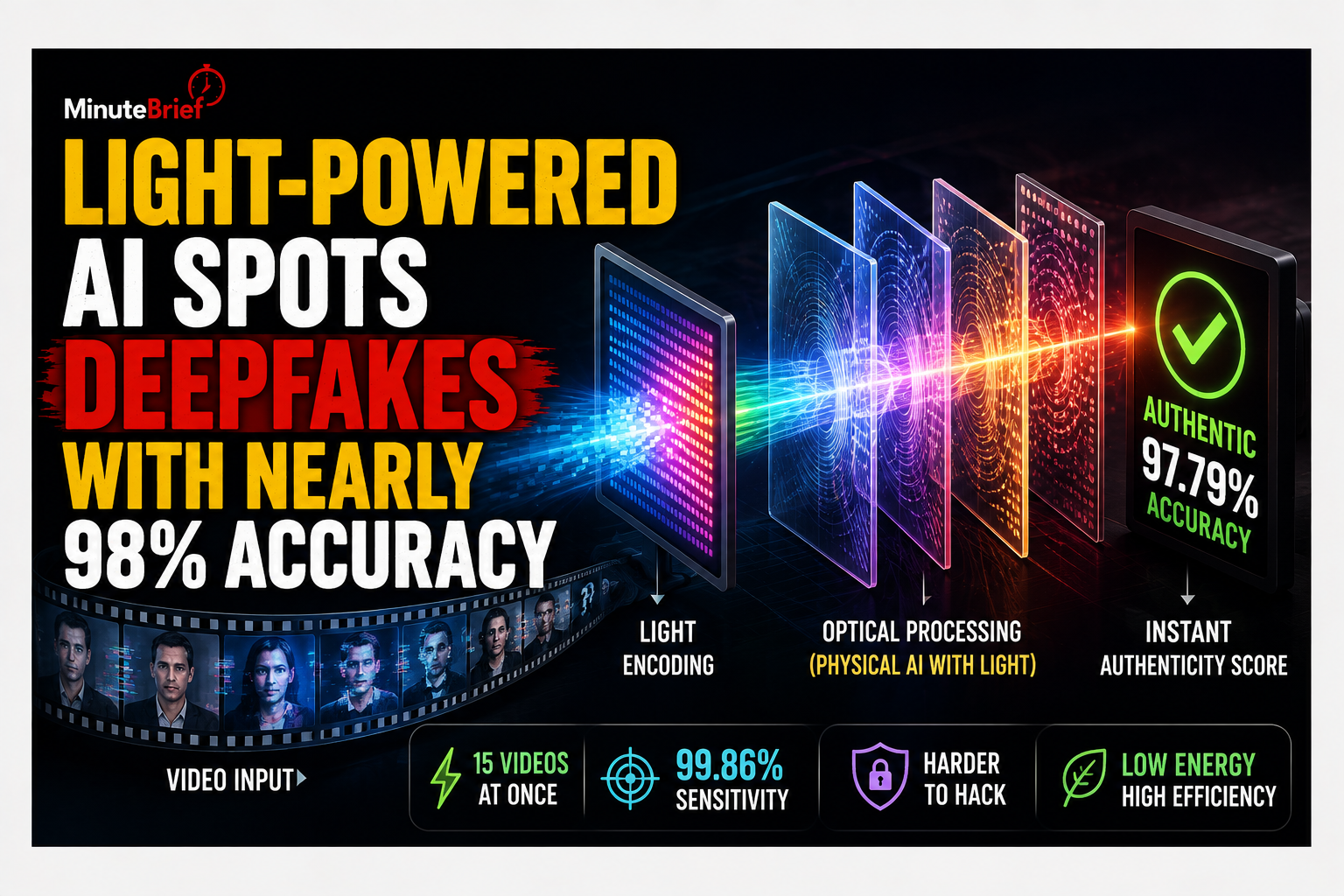
- Lightweight Encoding: A digital encoder converts key visual, spectral, and timing features of a video into a light pattern displayed on a programmable screen.
- Physical Processing: The light travels through custom, passive optical layers (diffractive surfaces). As the light bends and interacts with these layers, it physically completes the complex calculations needed to judge the video.
- Instant Results: Optical detectors at the other end immediately generate an authenticity score.
Because the calculations happen through physical light diffraction, adding extra optical layers boosts detection capabilities without increasing electrical power consumption.
Impressive Real-World Performance
During testing, the UCLA processor demonstrated remarkable speed, accuracy, and versatility:
- Massive Parallel Processing: The system analyzed 15 videos simultaneously in a single optical pass, achieving an average detection accuracy of 97.79%.
- Ultra-Low Error Rate: It achieved a 99.86% sensitivity rate, meaning only ~0.14% of manipulated videos managed to slip through undetected.
- Scalability: When pushed to process 18 videos at once, accuracy remained high at 96.13%.
- Tested Against Next-Gen AI: When challenged with advanced videos generated by models like Google VEO-3—which lack traditional deepfake visual glitches—the system adapted with minimal fine-tuning, hitting 94.80% accuracy.
Harder to Hack
Beyond speed and energy efficiency, the optical processor is inherently more secure against cyberattacks.
Because key parts of the AI system are physically embedded into optical hardware structures rather than stored purely as digital code, attackers cannot easily reverse-engineer the model to design bypass techniques. Tests also showed the system worked reliably even when videos contained blur, compression, or image noise.
A Powerful First Line of Defense
The researchers envision this light-powered processor working alongside traditional digital AI rather than replacing it entirely.
Massive streams of internet video could first pass through the optical processor to screen hundreds of videos at once. Any flagged or suspicious clips could then be forwarded to deeper digital systems for a final review—creating a fast, energy-efficient, and highly secure framework for media authentication and content moderation.