In Brief
- Primordial black holes could be as small as a single atom while packing the mass of an asteroid (roughly one-millionth of Earth's mass).
- Once captured inside a star via multi-body gravitational interactions, the black hole settles into the core and consumes about 1% of the star's mass over several million years.
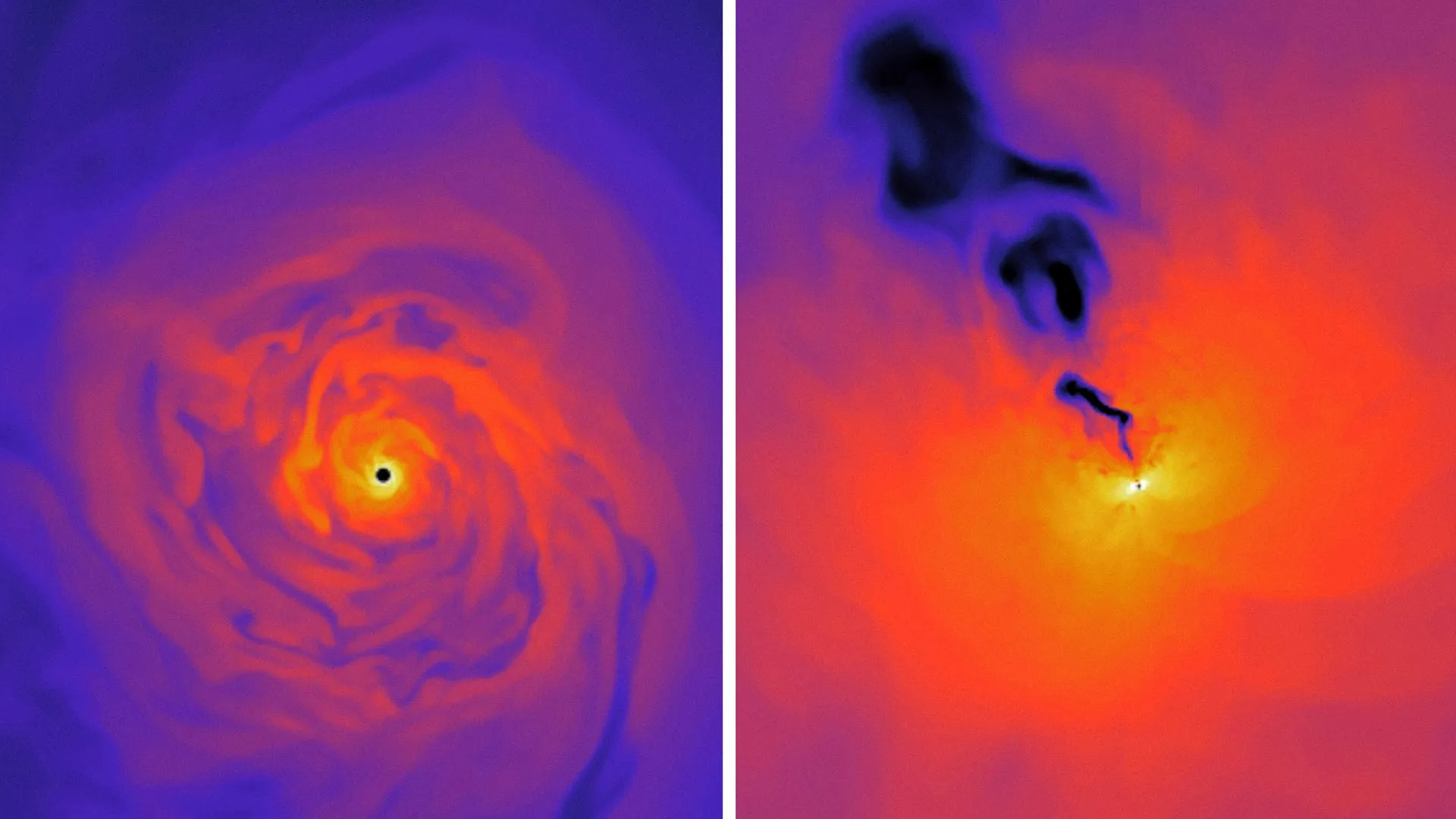
- A spinning accretion disk forms around the black hole, twisting magnetic fields to fire powerful polar jets that obliterate the star in a few dozen seconds.
- The resulting blue, ultraviolet, X-ray, and gamma-ray outburst offers astronomers a direct observational signature to confirm primordial black holes and constrain their role in dark matter.
How an Atom-Sized Black Hole Destroys a Star
Unlike stellar-mass black holes formed from collapsing giant stars, primordial black holes are theorized to have formed from ultradense pockets of matter moments after the Big Bang. While the smallest ones would have evaporated long ago via Hawking radiation, asteroid-mass versions—spanning $10^{17}$ to $10^{23}$ grams—could still roam the cosmos today.
Using detailed stellar evolution simulations, MIT’s Ore Gottlieb and his co-authors modeled what happens when a Sun-like star captures one of these dense objects:
- Capture and Sinking: Through gravitational interactions involving a companion object, a passing primordial black hole slows down via stellar friction and sinks to the center of the host star.
- Core Feeding: Once at the core, the black hole absorbs energy and matter faster than earlier models predicted, consuming roughly 1% of the star's total mass over several million years.
- Jet-Driven Detonation: Infusing gas forms a rapidly spinning accretion disk around the black hole, twisting and amplifying magnetic fields until powerful electromagnetic jets erupt from its poles—punching through the star and blowing it apart in just a few dozen seconds.
A New Observational Window Into Dark Matter
The MIT team calculated that this stellar destruction would produce a bright, distinctive signature across the electromagnetic spectrum—dominated by intense blue and ultraviolet light, accompanied by X-rays and gamma rays—bright enough to be captured by existing sky-survey telescopes.
"The broader impact is that we can now place constraints on primordial black holes, and their contributions to dark matter, using observations," Gottlieb said. Detecting—or ruling out—these unusual stellar explosions could help resolve whether primordial black holes make up a major fraction of the universe's elusive dark matter.