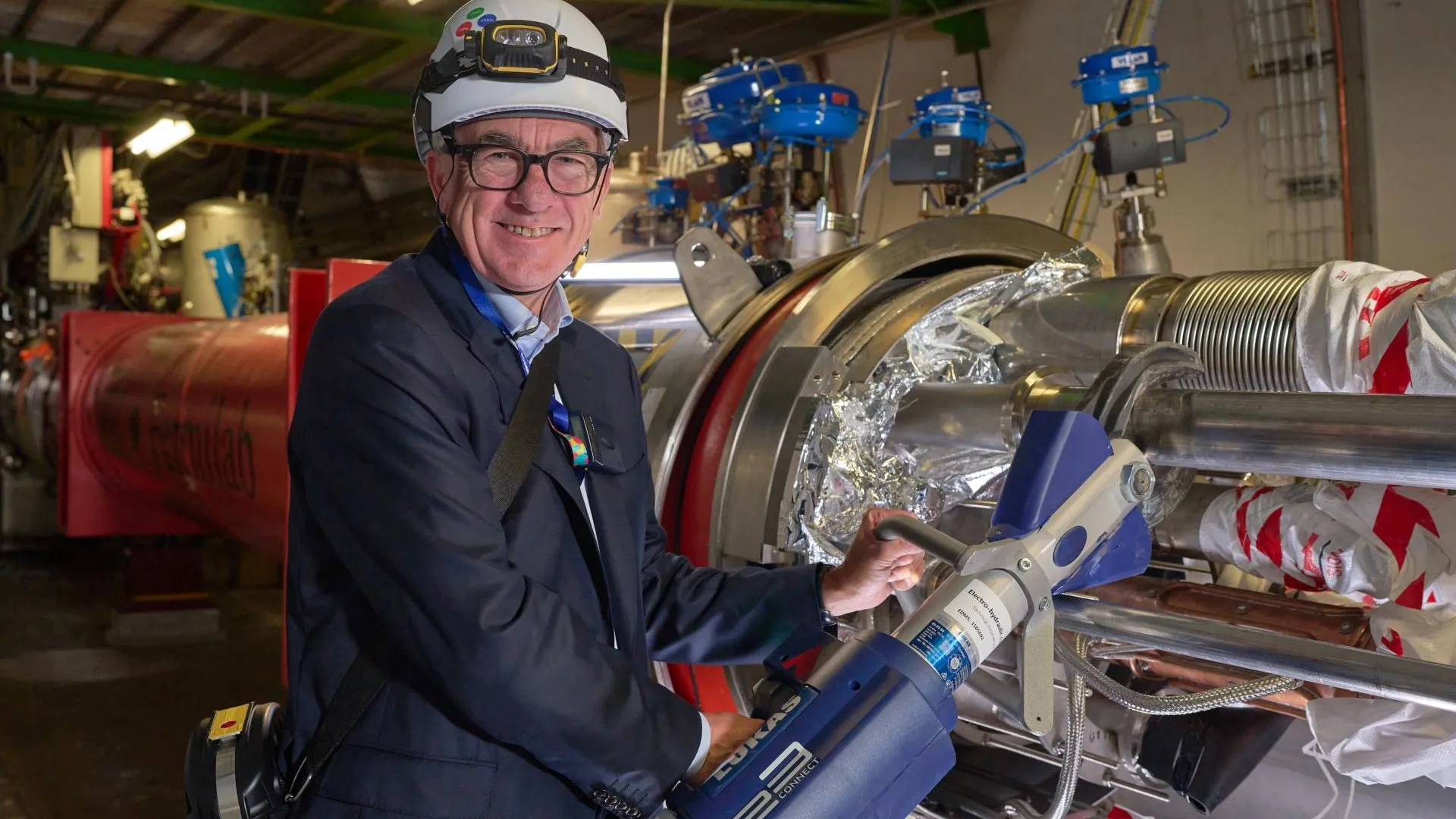
CERN has officially begun dismantling parts of the Large Hadron Collider (LHC) as part of a major overhaul: the High-Luminosity LHC (HiLumi LHC) project.
Teams have started cutting magnet interconnections and removing essential components along the 27-kilometer ring beneath the Swiss-French border, marking the official start of the third long shutdown (LS3).
Why Replace the Magnets?
The LHC relies on thousands of specialized magnets to steer and focus subatomic particle beams moving near the speed of light. Among the most critical are the inner triplets—groups of three quadrupole magnets positioned on either side of the giant ATLAS and CMS detectors.
Their job is to compress particle beams as tightly as possible right before they cross paths.
- Tighter Beams = More Collisions: Squeezing the beams increases collision probability.
- Higher Luminosity: More collisions generate vast amounts of new data for physicists studying the fundamental laws of nature.
A 40% Boost in Magnetic Power
The original inner triplets were installed between 2005 and 2007 using a niobium-titanium alloy. After nearly two decades of operation, they are giving way to a much more advanced generation of magnets.
The upgraded magnets utilize niobium-tin superconducting coils, allowing them to reach magnetic fields of 11.3 tesla—about 40% stronger than their predecessors. This massive leap in power will dramatically boost collision rates for the ATLAS and CMS experiments.
What Lies Ahead
Over the course of the shutdown, crews will remove 28 superconducting magnets to make room for the new hardware.
The first of the new quadrupole assemblies is expected to enter the tunnel in early 2029. In total, installation will involve 16 cryostats and 28 cryo-assemblies, setting the stage for a new era of high-precision particle physics discoveries.