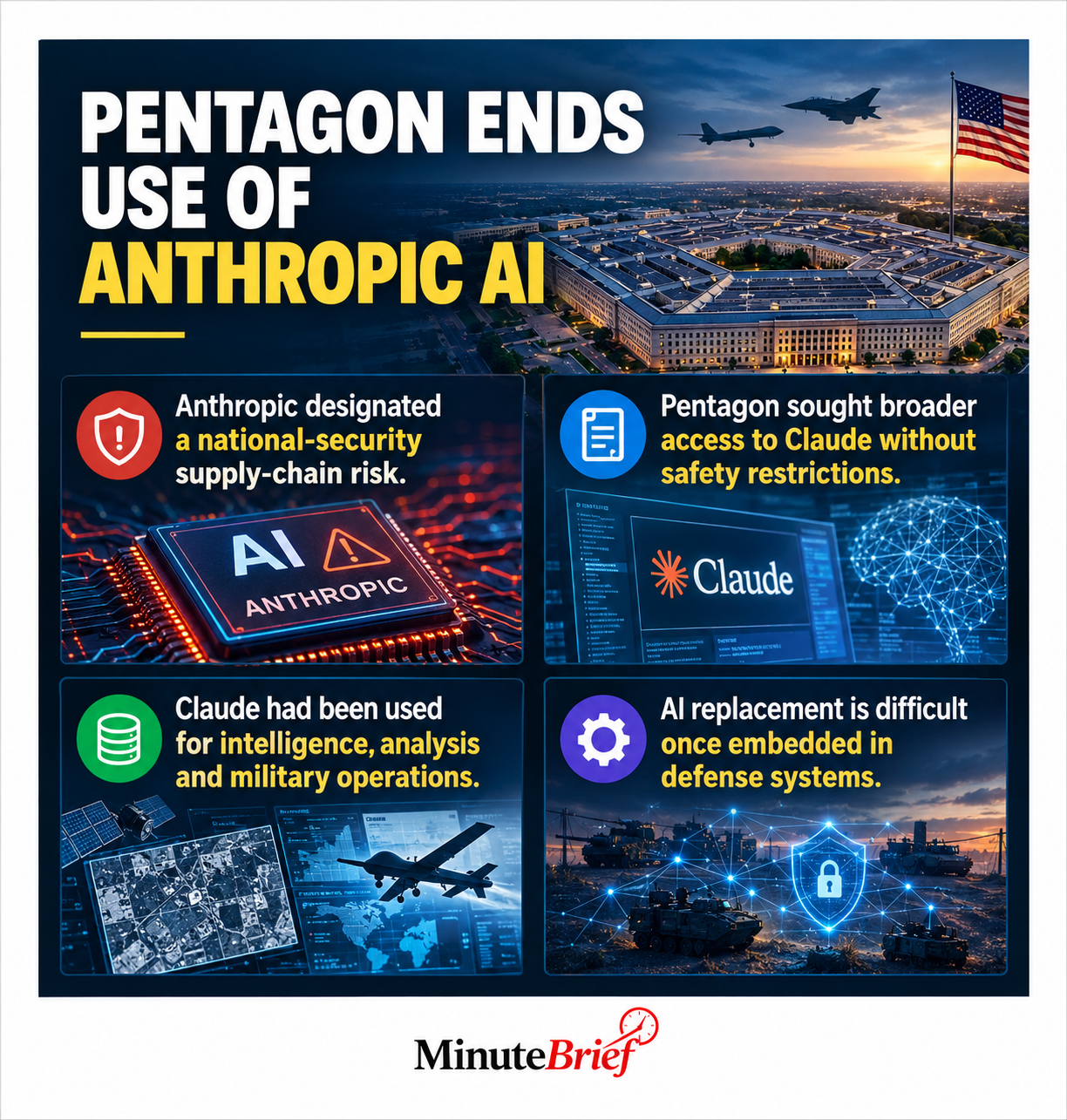
The U.S. Department of Defense has confirmed that the Pentagon has ceased using Anthropic’s AI tools, ending the company’s involvement with the U.S. military after months of controversy over national security, safety restrictions, and the use of artificial intelligence in defense operations.
The decision follows Defense Secretary Pete Hegseth’s designation of Anthropic as a “national security supply-chain risk” earlier this year. This came after Anthropic refused Pentagon demands for unrestricted access to its Claude AI models, citing concerns that removing safety safeguards could enable mass surveillance and autonomous weapons.
Despite the order to phase out Anthropic’s technology by late August, multiple sources familiar with Pentagon operations told the BBC that Claude was still used until recently for research, intelligence gathering, analysis, and military operations involving Iran. The system was valued for processing and organizing large volumes of information.
Anthropic’s AI was also deeply integrated into the Palantir Maven Smart System, a major Pentagon platform that organizes and analyzes intelligence. Defense personnel use Maven to work with data such as satellite imagery and drone footage, with AI models like Claude assisting in data analysis, identifying potential military targets, and preparing intelligence briefs.
The continued use of Claude after blacklisting highlighted the difficulty of removing AI systems once embedded in critical defense infrastructure. Experts noted these technologies are not simply “plug and play,” making replacement complicated when connected to broader operational systems.
The Pentagon’s dispute with Anthropic began when officials sought to remove the company’s safety restrictions and gain broader military access to its technology. Anthropic rejected these demands, prompting the Pentagon to classify the company as a supply-chain risk. Anthropic described this designation as “unprecedented and unlawful” and has challenged the administration in court.
Amid the dispute, the Pentagon expanded its use of AI tools from other major tech companies, including OpenAI, Google, and xAI. OpenAI’s systems have reportedly become more widely adopted in some defense departments.
This decision underscores a broader challenge facing governments as AI becomes increasingly important to national security: balancing the need for powerful, rapidly deployable technology with concerns over safety, control, supply-chain security, and potential military consequences of unrestricted AI systems.