In Brief
- Correcting Historical Geography: Scientists corrected an eight-kilometer location error for Qufu, the ancient capital of the State of Lu in China, aligning historical texts with modern orbital physics.
- Measuring Earth's Rotational Deceleration: Reconstructing the eclipse confirmed that Earth spun slightly faster 2,700 years ago, demonstrating long-term rotational slowing caused primarily by lunar tidal friction.
- Insights into Ancient Solar Activity: The ancient Chinese text provides one of the earliest known descriptions of the solar corona, yielding valuable comparisons for long-term solar cycle studies.
Resolving an Eight-Kilometer Astronomical Discrepancy
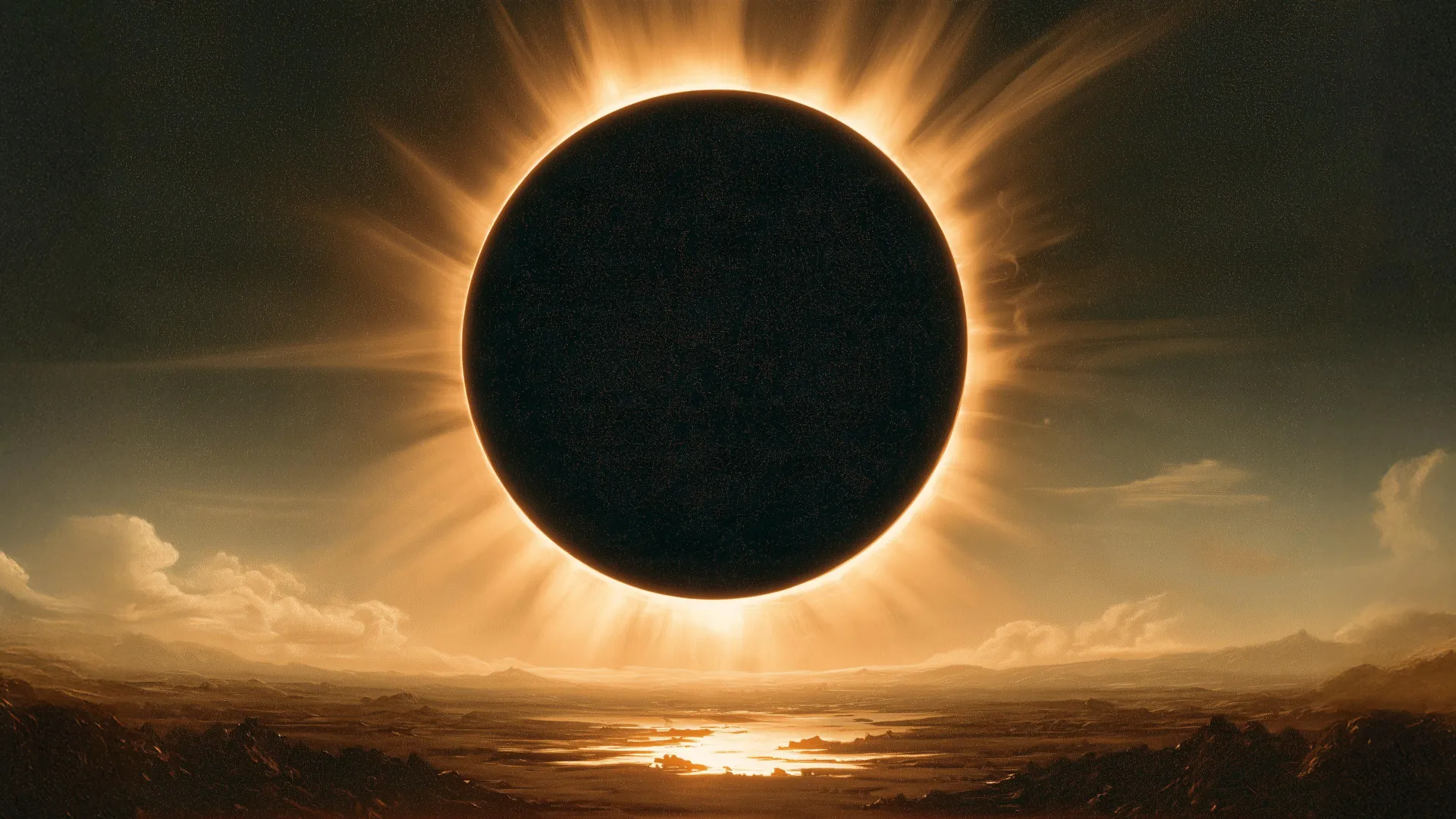
In a study highlighted by Nagoya University on October 26, 2026, researchers resolved a long-standing discrepancy involving the oldest datable record of a total solar eclipse, recorded on July 17, 709 BCE, in the ancient Chinese chronicle Spring and Autumn Annals.
Previous astronomical models had struggled to match modern orbital mechanics with the historical text.
The breakthrough occurred when an interdisciplinary team—combining expertise in astrophysics, history, and historical geography—identified that previous analyses used imprecise coordinates for the ancient capital of the Lu Duchy (modern-day Qufu in Shandong Province).
By shifting the observation point by eight kilometers to match the true site of the ancient court, the totality path aligned precisely with celestial calculations.
Earth's Rotation and Ancient Solar Activity
Earth's rotational speed is not constant; over millennia, tidal friction generated by the gravitational pull of the Moon gradually slows the planet's spin.
By pinning down the exact path of the 709 BCE totality zone, scientists obtained highly precise measurements of Delta T—the cumulative difference between uniform atomic time and Earth's actual rotation.
The historical account also included descriptive language consistent with the solar corona during a total eclipse, matching modern radioisotope measurements in tree rings that reconstruct past solar flare activity.
"Some of our ancestors were very skilled observers," noted study coauthor Dr. Meng Jin of the Lockheed Martin Solar and Astrophysics Laboratory. "When we combine their careful records with modern computational methods and historical evidence, we can potentially find new information about our planet and our star from thousands of years ago."