In Brief
- Astronomers detected a moon-sized object outside our Solar System.
- The discovery challenges traditional planet-moon definitions.
- The object is as massive as Jupiter orbiting a brown dwarf.
- This brown dwarf orbits a star, creating a unique celestial arrangement.
On October 24, 2026, astronomers announced evidence of the first exomoon— a moon beyond our Solar System. Unlike familiar moons, this object is at least as massive as Jupiter and orbits a brown dwarf. This brown dwarf, in turn, orbits a star, making the system distinctive in its gravitational and physical arrangement.
A Landmark Discovery Outside Our Solar System
In a potentially historic breakthrough for astrophysics, researchers have identified compelling evidence of the first known exomoon.
While astronomers have confirmed over 5,000 exoplanets in recent decades, detecting moons orbiting those distant worlds has proven extremely difficult due to their small size and faint light signatures.
This newly discovered candidate stands out not only because of its detection, but because of its astonishing scale: the object is at least as massive as Jupiter, making it drastically larger than any moon found within our own Solar System.
A Complex Three-Body System
The orbital dynamics of the system present a unique layout that challenges traditional planetary definitions:
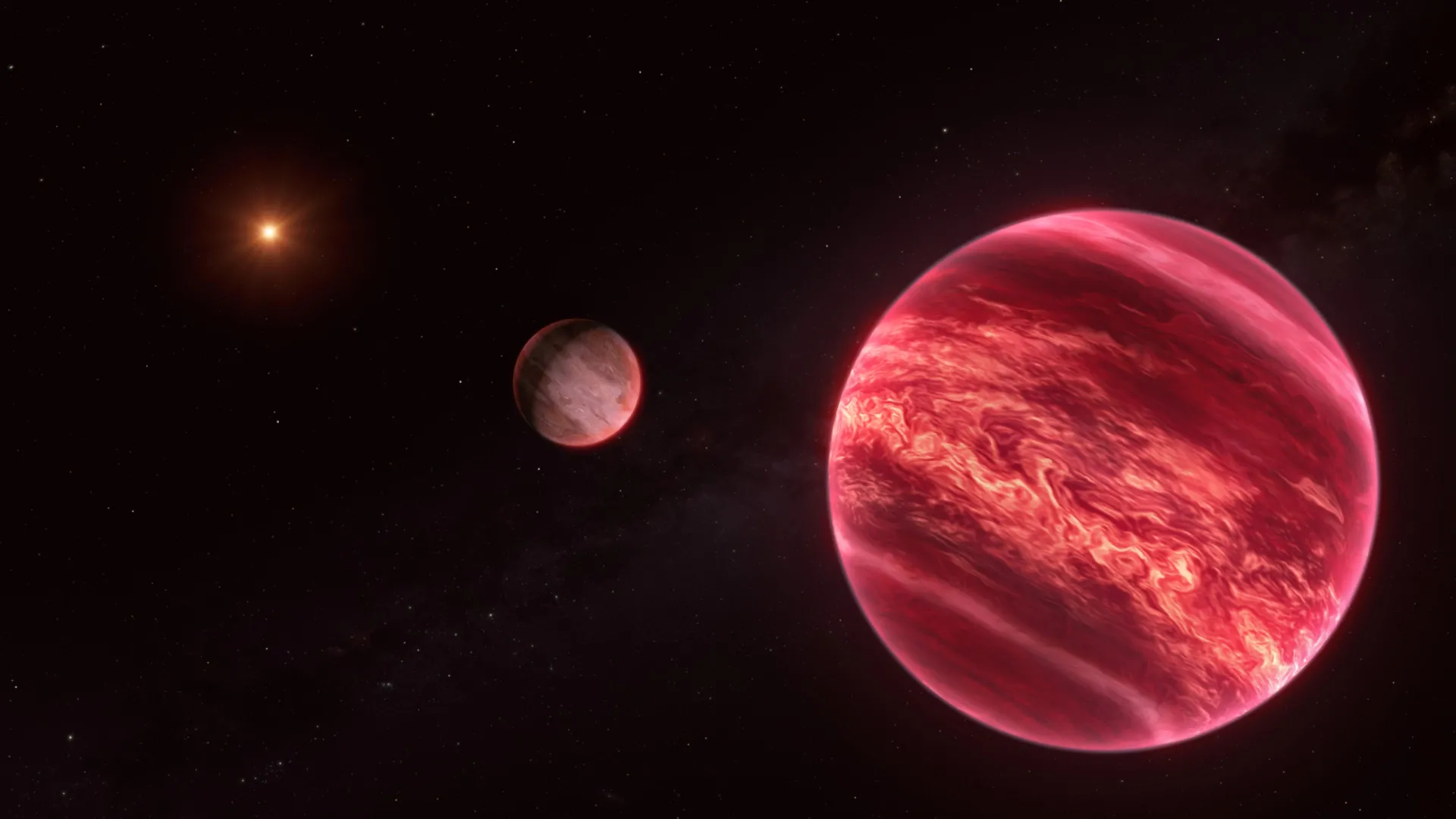
- Host Star: The primary star sits at the center of the system.
- Brown Dwarf: A large object, often referred to as a "failed star" because it is larger than a planet but lacks sufficient mass to sustain nuclear fusion, orbits the host star.
- The Candidate Exomoon: The Jupiter-sized object closely orbits the brown dwarf.
Because the host object (the brown dwarf) straddles the boundary between a massive planet and a small star, researchers are debating how to classify its satellite. If the central body is viewed as a planet, its companion qualifies as a moon. If the central body is viewed as a low-mass star, the system resembles a multi-star or multi-planet system instead.
"This system stretches our understanding of how moons and planets form. When a 'moon' is the size of Jupiter, it pushes traditional celestial definitions to their limits."
Impact on Planetary Formation Models
Standard models of planetary formation suggest that moons form either from debris left behind during a planet's creation or through gravitational capture. However, forming a moon as massive as Jupiter around a brown dwarf presents significant theoretical challenges.
Astronomers plan to conduct follow-up observations using advanced space- and ground-based telescopes to measure the object's mass and orbit precisely. These future studies aim to confirm whether the object is truly an exomoon and help scientists refine how celestial bodies form in complex planetary systems.