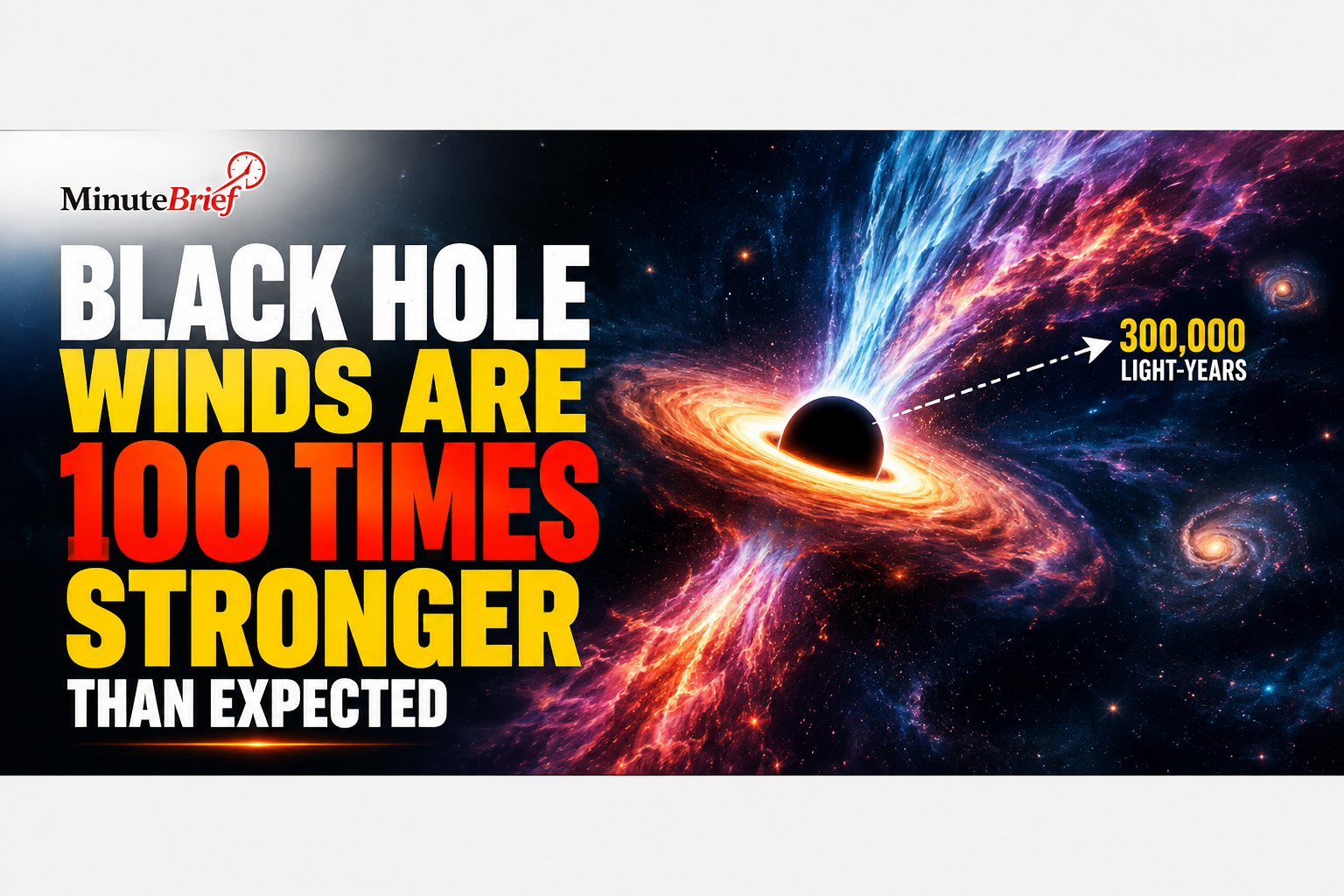
Supermassive black holes are famous for swallowing everything that gets too close, but they also blast massive gusts of gas back out into space. According to a study published in Nature Astronomy by researchers at Tohoku University, these black hole winds are around 100 times more powerful than previously estimated.
Instead of staying trapped inside their origin galaxies, these cosmic winds carry violent energy across roughly 300,000 light-years—reaching deep into intergalactic space.
Peering Into a Distant Quasar
Using the X-ray astronomy satellite XRISM, astronomers focused on H1821+643, an intensely bright quasar located 3.4 billion light-years away in the constellation Draco.
Quasars are powered by supermassive black holes actively consuming gas. As material spirals inward, it generates tremendous energy that heats surrounding gas and causes it to glow in X-rays. By analyzing emission lines from iron ions in this superheated gas, the research team was able to measure how fast and aggressively the material was moving.
Shockwaves That Span Light-Years
The high-precision measurements revealed extreme turbulence stirring the surrounding gas far beyond expected limits:
- Massive Reach: The gas turbulence extends nearly 300,000 light-years from the black hole, easily surpassing the boundaries of its host galaxy.
- Incredible Energy: The energy driving this movement is 100 times greater than earlier models predicted.
- Supernova Scale: The sheer force behind this turbulent flow equals the power of several billion supernova explosions combined.
Shaping the Cosmos
These findings show that supermassive black holes do far more than clear out their local neighborhoods. By driving massive, supercharged shockwaves across vast distances, they actively heat and redistribute gas across galaxy clusters.
This far-reaching influence plays a major role in shaping how galaxies evolve, controlling how gas flows and moves throughout the universe over billions of years.