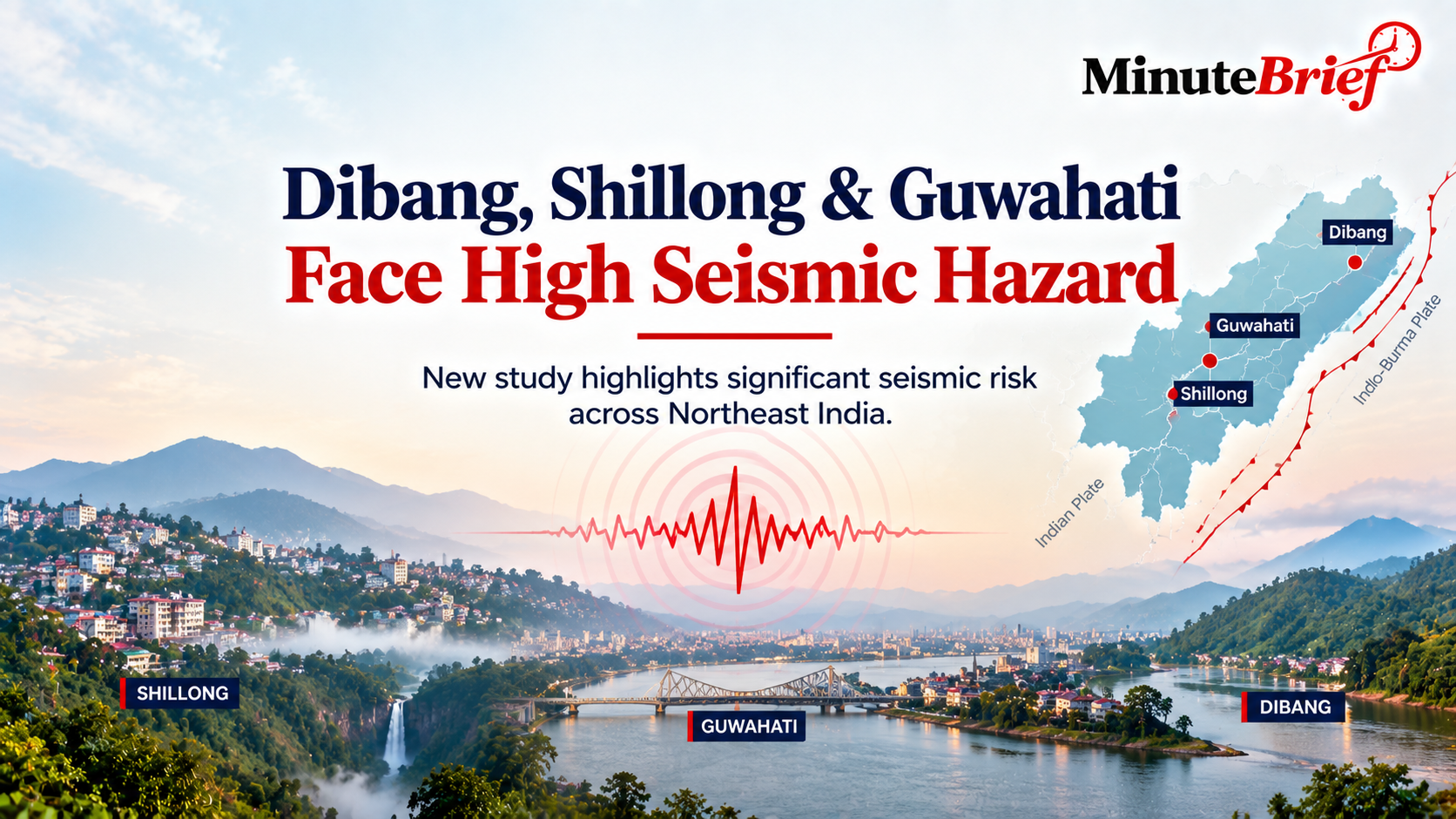
In Brief
- Researchers conducted an updated seismic hazard study across Northeast India using the Mwg(Das magnitude scale) revised magnitude scale to improve structural risk modeling.
- High peak ground acceleration values were recorded across major urban and ecological zones, with Shillong, Dibang, and Guwahati highlighting significant ground motion vulnerability.
- The study emphasizes an urgent need to re-evaluate local building safety codes, infrastructure resilience, and disaster response protocols across these vulnerable zones.
A comprehensive seismic hazard study evaluating Northeast India has highlighted heightened earthquake risks for major regional centers, including Dibang, Shillong, and Guwahati. Utilizing the revised Mwg(Das magnitude scale) to address historical data inaccuracies below 7.5 magnitude, researchers produced updated probabilistic hazard assessments detailing expected ground motion levels across key tectonic zones.
The findings show elevated peak ground motion values across active fault lines—notably along the Shillong Plateau (Dauki Fault system), the Mishmi Massif surrounding the Dibang region, and the urban corridors of Guwahati. Highlighting the potential for severe ground shaking, experts behind the study have urged policymakers and urban authorities to immediately reassess regional building safety codes, reinforce critical infrastructure, and strengthen emergency response strategies to mitigate earthquake risks.