India’s elections do not derive their legitimacy merely from the fact that polling takes place on time. They derive it from the public’s faith that the institution conducting those elections is impartial, transparent and independent. That is why the latest controversy surrounding Chief Election Commissioner Gyanesh Kumar deserves attention beyond partisan politics.
A report by The Indian Express has highlighted instances in which Election Commissioners Sukhbir Singh Sandhu and Vivek Joshi recorded objections on 14 occasions over decisions taken by the Election Commission. The objections were issues relating to adding voters, deleting voters, restoring voters, and filing appeals that are core to the Election Commission's mandate.
The Election Commission has responded that differences of opinion are a normal part of internal deliberations and that its final decisions were unanimous. Both facts can coexist. And that is precisely why the issue deserves a closer examination.
Dissent within a constitutional institution is not necessarily a weakness. It can, in fact, be evidence of institutional debate. The real question is what happens after dissent is recorded. Are objections meaningfully considered? Are reasons documented?
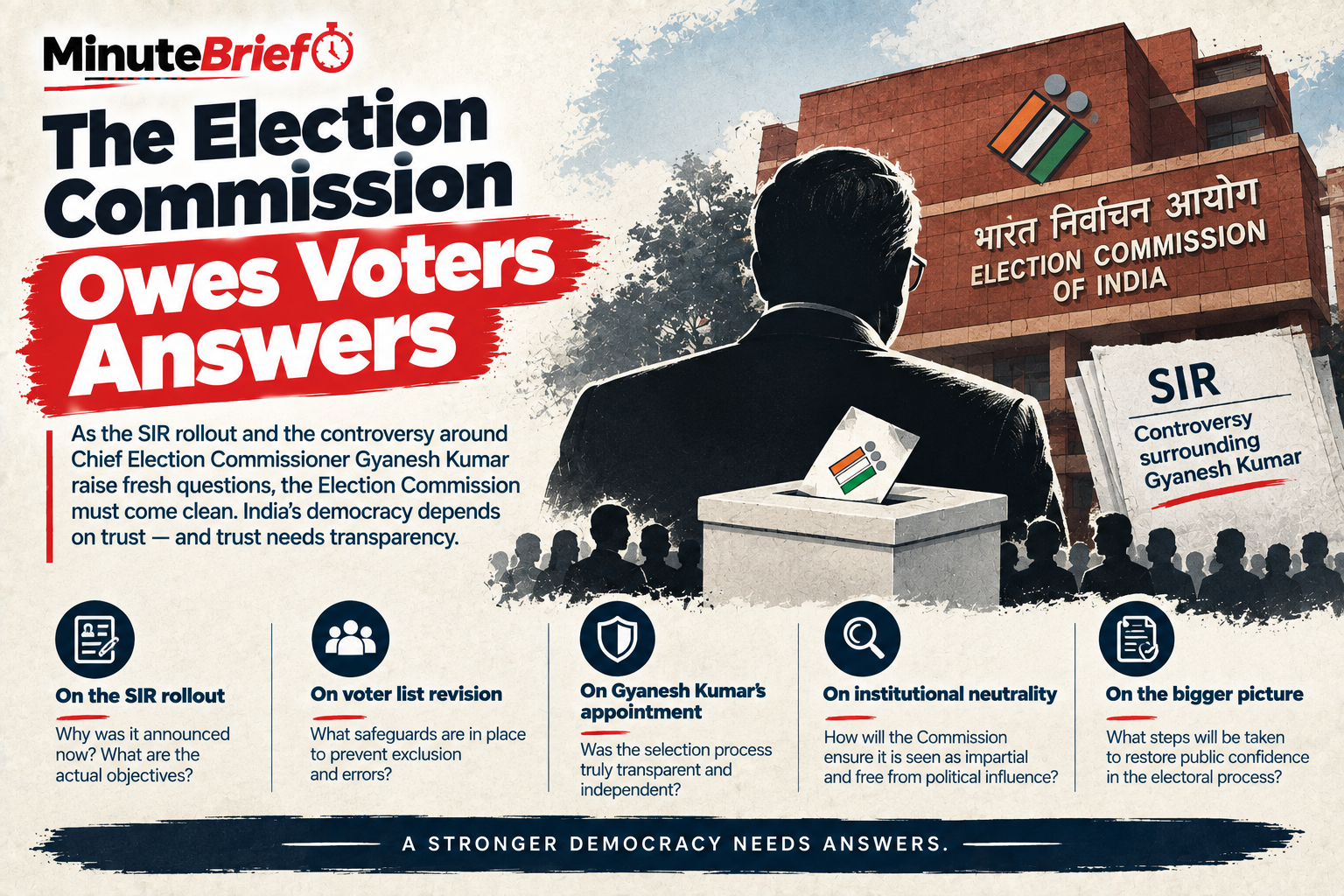
This becomes particularly important in the context of the Special Intensive Revision (SIR) of electoral rolls.
Reports and court proceedings surrounding SIR have raised questions about the deletion and restoration of voters’ names, the handling of appeals and the mechanisms available to correct errors. In West Bengal, for instance, the process has involved large-scale deletions, subsequent claims and judicial scrutiny. The very fact that substantial numbers of voters have had to seek restoration underlines how consequential electoral-roll decisions can be. The concerns are not limited to one state. In Goa, the Supreme Court directed that voters flagged for “logical discrepancies” during the SIR process be given an opportunity to submit documents and be heard before the final electoral roll was published. In cases where voters were subsequently found eligible, concerns were raised that corrections could not be carried out because the necessary rollback or access was not provided, despite repeated requests from the Chief Electoral Officer. If a correction is required and the competent authorities repeatedly seek the ability to make that correction, but the system remains unchanged, the issue is no longer simply one of technology. It becomes a question of administrative accountability: who had the authority to act, why was the correction not carried out, and why were eligible voters ultimately left at risk of deletion?
There have also been questions over changes to Form 6, including allegations that modifications made on the electoral portal were not promptly reversed despite objections.
These matters require careful investigation rather than political speculation. But they also point to a larger principle: administrative procedure cannot become a substitute for accountability.
For an ordinary voter, an electoral roll is not merely a government database. It is the gateway to one of the most basic rights in a democracy.
If a voter’s name is removed, there must be a clear reason. The voter must receive adequate notice and a meaningful opportunity to challenge the decision. If an error occurs, there must be a functioning and time-bound mechanism to correct it. And if technology is used to administer the process, that technology must itself be capable of independent audit and correction.
This is where the distinction between dissent and wrongdoing becomes important.
Disagreement among Election Commissioners is not inherently alarming. Constitutional institutions can—and should—accommodate disagreement. What would be deeply troubling is if electoral decisions were taken or implemented without proper authority, without due process, or in a manner that makes correction impossible.
Trust is built through transparency.
The Election Commission does not belong to any political party. It belongs to India’s constitutional framework. Therefore, criticism of the Commission should not automatically be dismissed as an opposition conspiracy.
The appropriate response is neither unquestioning faith nor political suspicion. The controversy is ultimately bigger than Gyanesh Kumar, or any individual who occupies the chair of the Chief Election Commissioner.
A democracy cannot depend on the personal reputation of the person heading its election machinery. It needs institutions whose procedures command confidence regardless of who occupies the office.
The Commission can strengthen that confidence by publishing clearer explanations of contentious decisions, maintaining transparent records of significant objections, making electoral-roll corrections independently auditable and ensuring that wrongly excluded voters have quick and effective remedies.
The question is whether the Indian voter can trust the process by which their name remains on the electoral roll—and, ultimately, their vote remains their own.