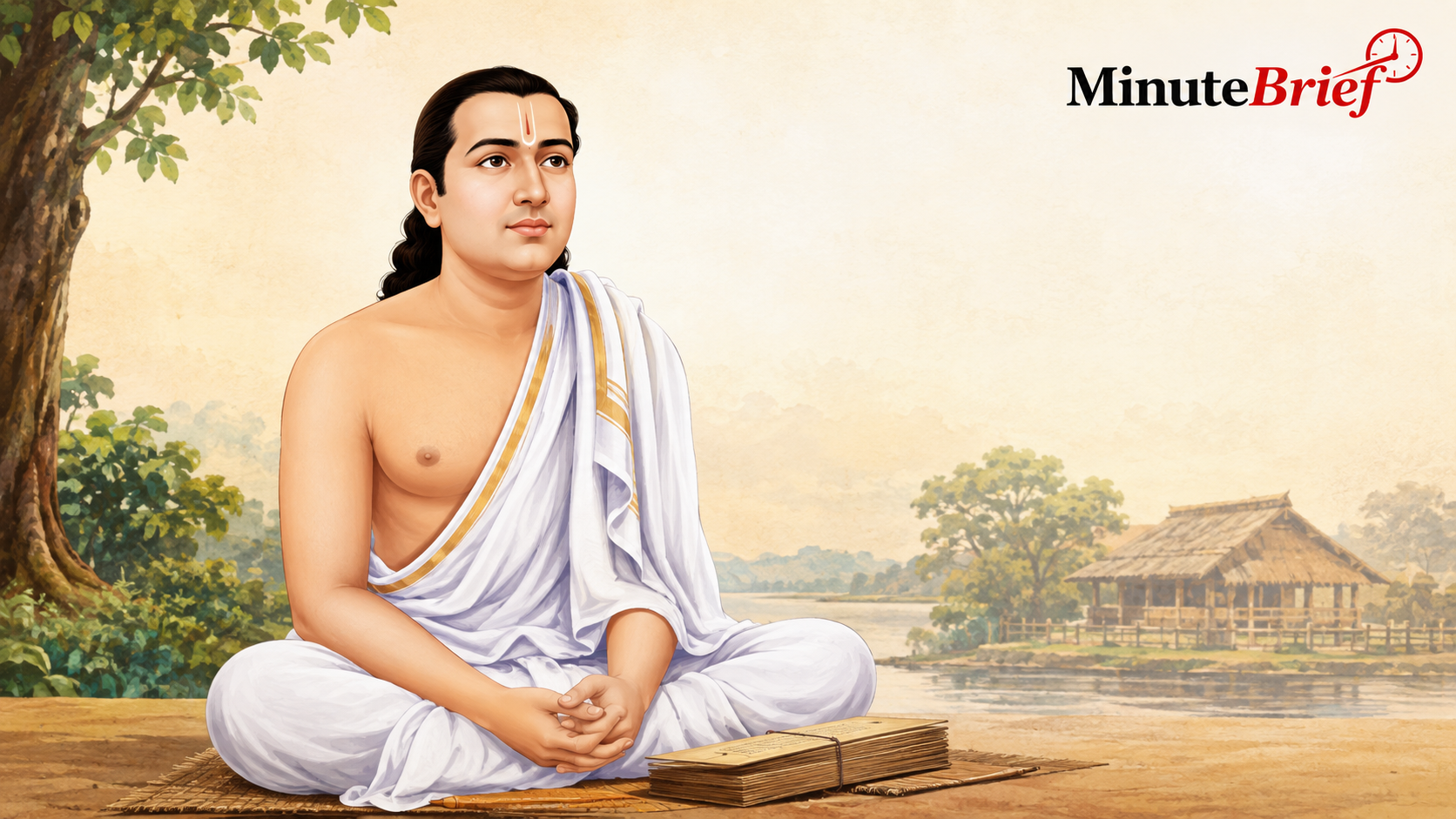
Today, September 21, marks the 578th birth anniversary of Mahapurush Srimanta Sankardeva, one of the most influential, spiritual, literary and cultural figures in Assam’s history.
For readers outside Assam who may be unfamiliar with his name, Sankardeva was a saint, poet, philosopher and social reformer whose contributions helped shape the region’s spiritual and cultural identity. For generations of Assamese people, however, he is more than a name in history. His words and creations are part of a shared cultural memory.
For many, that connection begins in childhood, in a school classroom, with the beautiful lines of “Karatala Kamala, Kamala-dala Nayana" meaning Thy palm is like the lotus; Thine eyes are like the lotus petals." According to biographers, Sankardeva composed this brilliantly structured poem at the age of 12, on his very first day of school (at the tol, or academy, of scholar Mahendra Kandali). His teacher had assigned the class a poetry task. Because young Sankardeva had only just been introduced to the basic alphabet and had not yet been taught the vowel signs, he bypassed them entirely to create a flawless, deeply moving devotional lyric. The poem’s rhythm and imagery can leave a lasting impression, even before its deeper meaning is fully understood. Something is mesmerising about discovering such beauty in a few lines of poetry. What begins as a lesson in a textbook can become an introduction to the remarkable literary genius of Srimanta Sankardeva.
But his contribution extends far beyond poetry. Sankardeva played a central role in shaping Assam’s spiritual and cultural life. Through Ekasarana Dharma, he emphasised devotion to one God and promoted values of compassion, equality and unity. His teachings reached ordinary people through accessible forms of literature, music and performance, helping make religious and cultural life a shared experience.
His creative influence can still be seen across Assamese traditions. He composed Borgeets, devotional songs known for their spiritual depth and musical beauty, and developed Ankiya Naat, a form of devotional drama performed through the tradition of Bhaona. His influence also helped shape Sattriya, now recognised as one of India’s classical dance forms. Through these artistic expressions, Sankardeva brought stories and spiritual ideas to life while leaving an enduring mark on Assamese culture.
His literary works, particularly Kirtana Ghosha, remain important parts of Assamese devotional literature. The Namghars and Satras associated with his movement also became vital centres of prayer, learning, cultural expression and community life. Their continuing presence reflects how deeply his vision became woven into the social fabric of Assam.
For those discovering Sankardeva from outside the state, these contributions offer a window into the richness of Assamese heritage. For those who grew up with his poetry, songs and traditions, they carry something more intimate—a sense of familiarity and belonging. A poem remembered from school, a melody heard during prayer or a Bhaona watched in a community gathering can connect generations in ways that historical accounts alone cannot.
That is why his birth anniversary is not merely an occasion to remember a great figure of the past. It is also a moment to reflect on how one person’s creativity and vision can continue to influence a society centuries later. Sankardeva’s life reminds us that literature can move hearts, art can bring people together, and cultural traditions can remain alive when they are passed from one generation to the next.
Centuries have passed since Sankardeva’s time, yet his words continue to be read, his songs continue to be sung, and his artistic traditions continue to be practised. For many, it all began with a few memorable lines in a schoolbook.
Perhaps that is the true beauty of Srimanta Sankardeva’s legacy: a name that may be new to some, but a voice that has never grown old for generations of Assam.