There was a time when the idea of a machine writing an essay, creating an image, analysing a medical report or having a meaningful conversation with a human seemed like something straight out of a science-fiction film. Today, these things can happen within seconds.
Artificial Intelligence has moved far beyond being a specialised field of computer science. It has quietly entered our everyday lives, helping us search for information, learn new things, perform tasks, run businesses and even support doctors and researchers. Its rise has been remarkably fast, and naturally, it has also created a great deal of discussion and fear.
But with every great invention comes a difficult question: Will Artificial Intelligence eventually take over humans?
I don't believe it will.
AI is undoubtedly one of the most powerful technologies humans have ever created. But that is exactly where the answer lies: we have created it. We designed it to solve problems, save time, increase efficiency and meet human needs. It is a product of human intelligence, not something that appeared independently of us.
That does not mean we should ignore the dangers. It means we should understand them without allowing fear to overshadow the enormous possibilities AI offers. The strongest reason for supporting AI is simple: it can help people achieve more.
In healthcare, AI can assist doctors in analysing medical images, patient records and scientific data. In education, it can help students understand difficult subjects and assist teachers with routine work. In scientific research, it can process enormous amounts of information and help researchers discover patterns much faster.
AI can also perform dangerous or physically demanding work, allowing humans to stay away from hazardous environments. In many situations, therefore, AI is not taking humanity's place; it is extending what humans are capable of doing.
And yet, this power comes with challenges that should not be ignored.
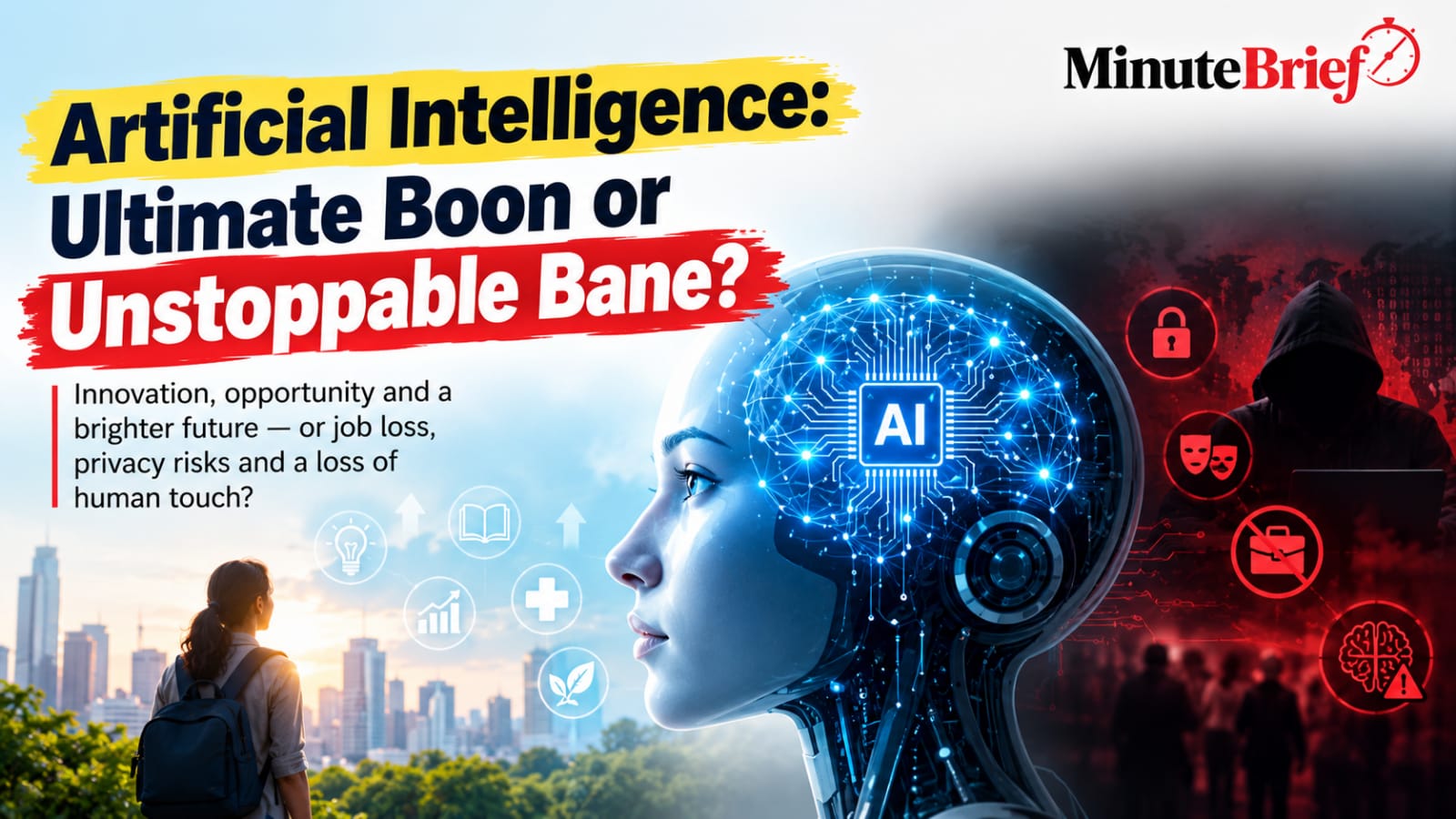
People are understandably worried about jobs being replaced, misinformation spreading, privacy being threatened and AI being misused. If people become completely dependent on AI or allow it to make important decisions without human supervision, the technology could certainly cause harm.
But this is precisely why I believe the real danger is not AI itself. The danger lies in how humans choose to use it.
This is where I believe we need to look beyond what AI can do and consider what it cannot be.
AI can analyse information, recognise patterns and generate remarkably convincing text, images and even music. But human beings possess something far more complex: emotion, empathy, intuition, experience, imagination and moral judgement.
A machine can write about love, but it does not experience love. It can describe sadness, but it does not feel grief. It can discuss courage, but it does not understand what it means to sacrifice something for another person.
These are not simply pieces of information that can be stored in a database. They are part of the human experience.
That is why I do not believe AI can completely take over humanity. It may become faster, smarter and more capable, but intelligence alone does not make something human.
Perhaps the greatest risk is not that AI will suddenly become our enemy, but that we will become too willing to surrender our own thinking to it. If we allow machines to write everything for us, solve every problem and make every decision, we may slowly become less willing to think for ourselves.
AI should make us more capable, not more passive. It should be an assistant to human intelligence, not a replacement for it.
AI is developing faster than many of our laws and institutions can keep up with. That is why some form of responsible development is essential. At the same time, we should not allow fear to stop useful innovation.
For me, the future should not be a battle between humans and machines. It should be a partnership.
A doctor can use AI without giving up compassion. A teacher can use AI without losing the human connection with students. A journalist can use AI to work faster while still relying on judgement and responsibility. In the same way, all of us can use AI as a powerful tool without allowing it to define who we are.
I believe AI is ultimately a boon—provided we use it wisely.
There is nothing inherently evil about Artificial Intelligence. It is a creation of human beings, developed largely to address human problems and needs. Like any powerful invention, it can be misused, but misuse does not make the technology itself a curse.
AI can calculate faster than us. It can process more information than us. It can assist us in ways we could never have imagined.
But I don't believe AI will completely take over humans. It may change the way we work, learn and live, and it may become far more capable than it is today. But intelligence alone does not replace the depth of human emotion, judgement, creativity and consciousness.
AI can calculate. Humans can understand.
AI can generate. Humans can imagine.
AI can assist. Humans can choose.
And perhaps that is the most important point of all.
We created AI to serve human needs. If we continue to develop and use it with wisdom, responsibility and compassion, there is no reason for it to become our enemy.
The future should not be about humans competing with AI. It should be about humans using AI to build a better future—without ever forgetting what makes us human.