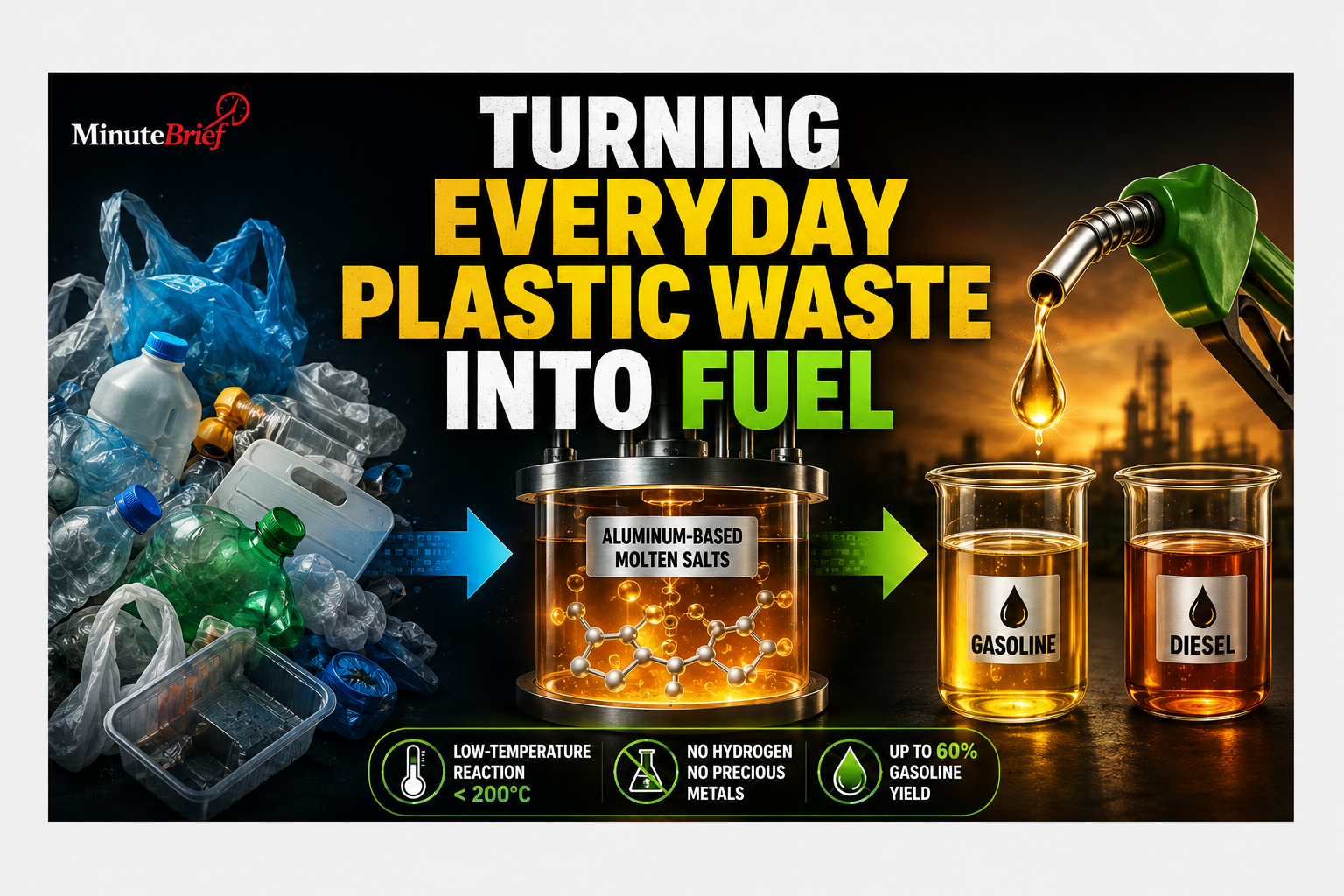
Scientists at Oak Ridge National Laboratory (ORNL) have developed a low-temperature process that converts common plastic waste into gasoline and diesel-like fuels, offering a potential breakthrough for managing global plastic waste.
The study, published in the Journal of the American Chemical Society, targets polyethylene—the world's most widely produced plastic, commonly used in shopping bags and cutting boards.
Traditional plastic recycling methods rely on intense heat of 450°C to 500°C (840°F–930°F), along with expensive noble-metal catalysts and added hydrogen gas. The ORNL team bypassed these requirements by using aluminum-based molten salts as both the reaction liquid and the catalyst:
- Acidic Catalytic Sites: Charged aluminum atoms inside the salt form acidic sites that snip long polyethylene chains into smaller hydrocarbon molecules.
- Low-Temperature Reaction: The chemical conversion occurs below 200°C (392°F)—comparable to a standard kitchen oven—and achieved a 60% gasoline yield in laboratory tests.
- No Added Hydrogen or Precious Metals: The system operates without external hydrogen gas, chemical initiators, or costly noble metals.
Researchers also discovered that starting polymer structures dictate the final output: simpler polymer chains break down into gasoline-like compounds, while more complex chains produce heavier, diesel-like fuels.
Because polyethylene waste is abundant and aluminum-based molten salts are inexpensive, this low-energy process offers a promising pathway for industrial-scale plastic upcycling. The team is currently working to improve the long-term stability of the moisture-sensitive salts to prepare the technology for real-world application.