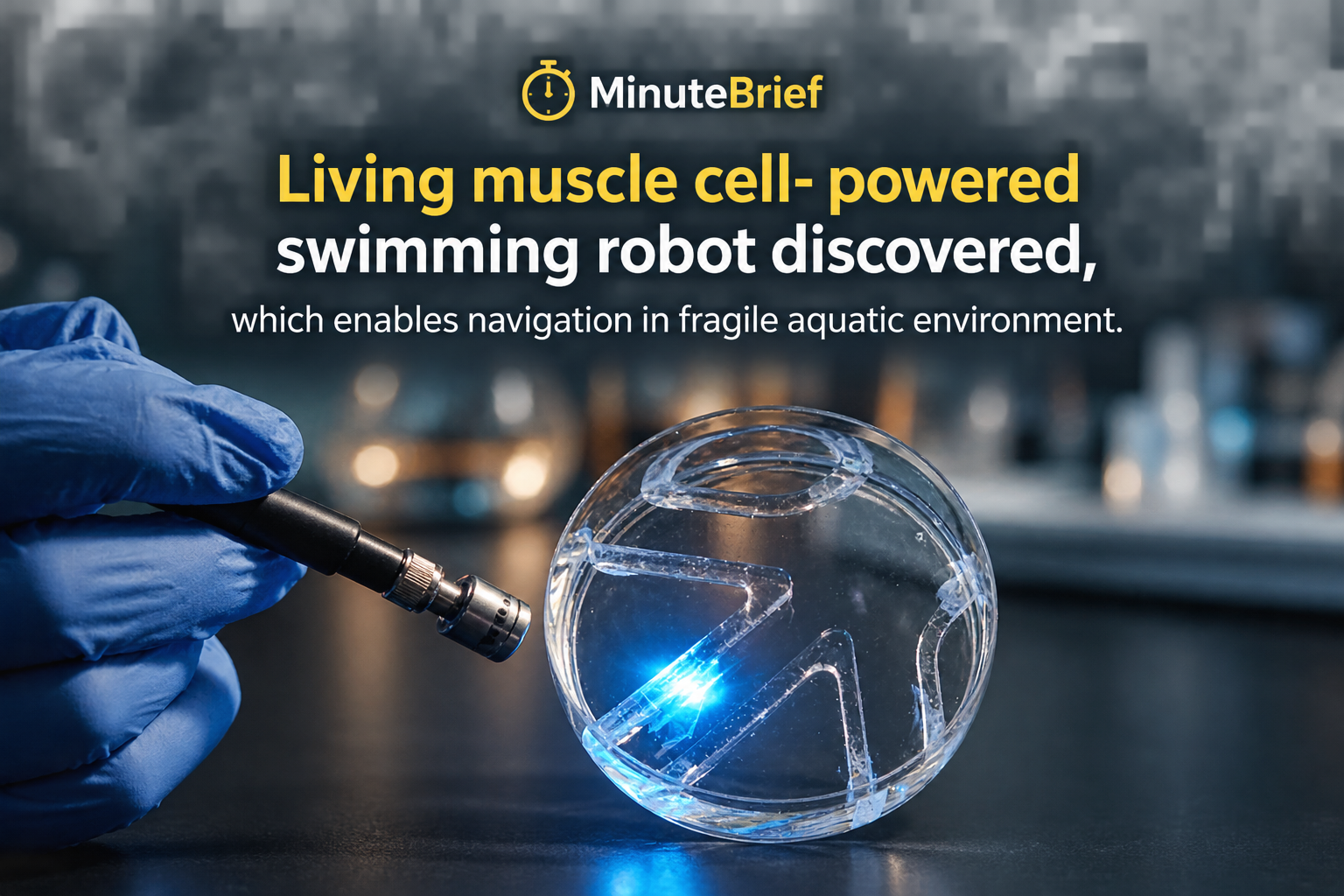
In Brief
- MIT engineers created a tiny robot that swims using living muscle cells.
- The robot uses light-responsive muscle cells to swim and steer in water.
- It is paper-thin, enabling navigation in fragile environments.
- The development could lead to self-healing biological robots for delicate explorations.
MIT engineers develop living muscle cell-powered swimming robot
Scientists at the Massachusetts Institute of Technology (MIT) have designed and built a miniature, paper-thin swimming robot powered by living muscle cells that respond to flashes of light. This breakthrough merges bioengineering with robotics to create a machine capable of controlled swimming and steering in water by activating muscle cells with light stimuli.
The robot's structure, just a few cells thick, integrates living muscle tissue that contracts and relaxes when exposed to specific light patterns. This enables its movement through liquid environments in a way that mimics natural swimming motions. The capacity to steer using light allows precise navigation without conventional motors or electronic actuators.
This development is significant because it opens pathways toward creating tiny biological robots that can self-repair and operate in fragile, sensitive environments where standard mechanical robots might cause damage or be ineffective. Potential applications include exploration and monitoring of delicate marine ecosystems, environmental sensing, or medical uses in fluid environments inside the human body.
The research builds on prior advances in biohybrid robotics, utilizing living cells to generate movement. By employing light-responsive muscle cells, the team achieved a high degree of control over the robot's swimming direction and speed. The paper-thin design is crucial for enabling the robot to navigate confined spaces and reduce environmental disturbance.