Physicists at CERN have recreated a microscopic version of the early universe using atomic nuclei far smaller than previously thought possible.
The Breakthrough
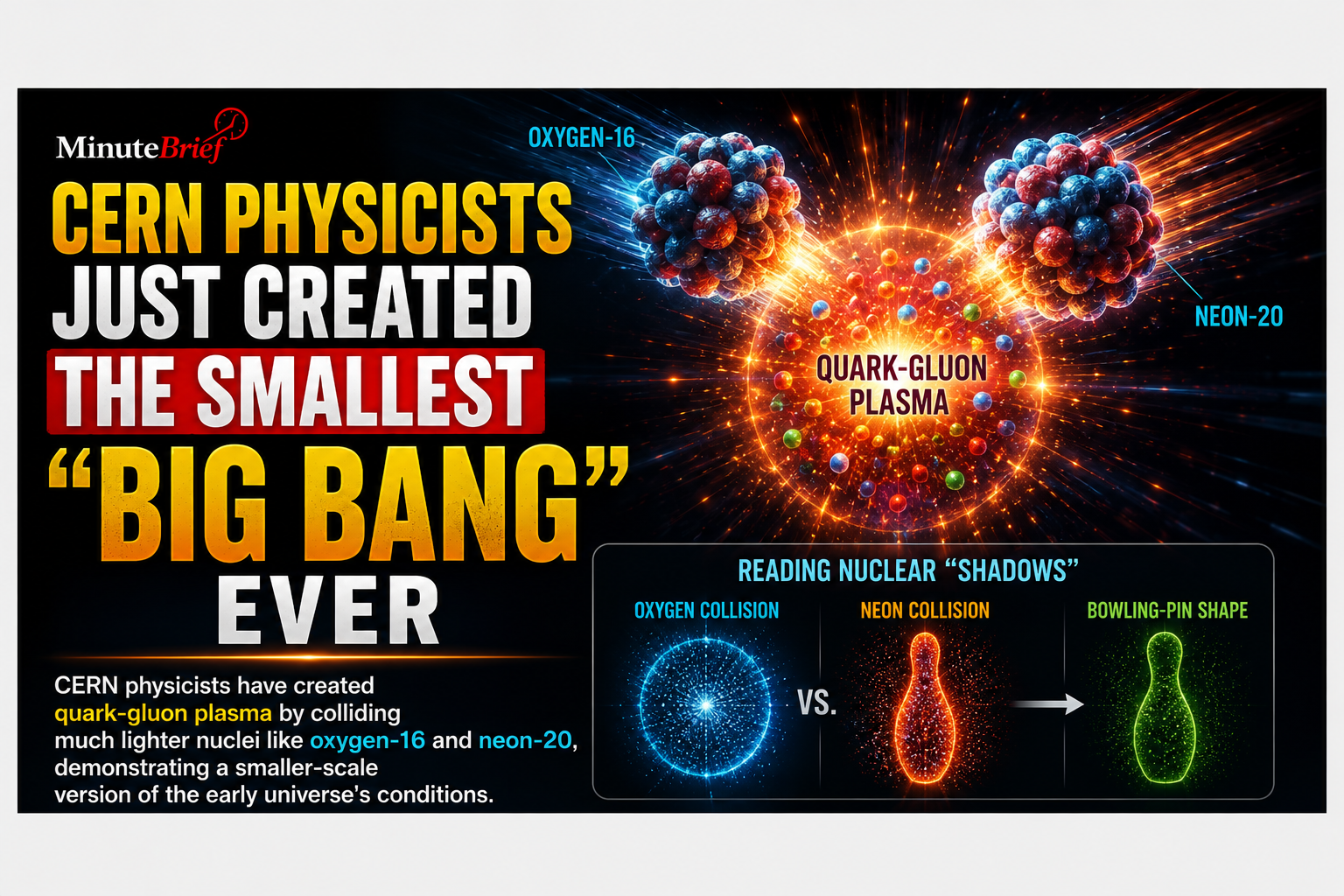
- Primordial Plasma: Colliding oxygen-16 and neon-20 nuclei at near-light speeds created quark-gluon plasma—the ultra-hot state of matter from the universe's first millionth of a second.
- Redefining Limits: Long believed to require heavy nuclei like lead, this experiment proves much lighter nuclei can form the plasma, pushing the boundary for how small a "Little Big Bang" can be.
Reading Nuclear "Shadows"
- Shape Memory: Expanding particles mirror the exact geometry of the original colliding nuclei.
- Bowling Pins vs. Spheres: Round oxygen collisions yield circular particle spreads, while neon collisions leave a distinct bowling-pin shape.
- A New Diagnostic Tool: By reading particle trajectories like a shadow, physicists can now decode the inner structure of atomic nuclei and better understand the strong force holding matter together.
Source: Science Daily