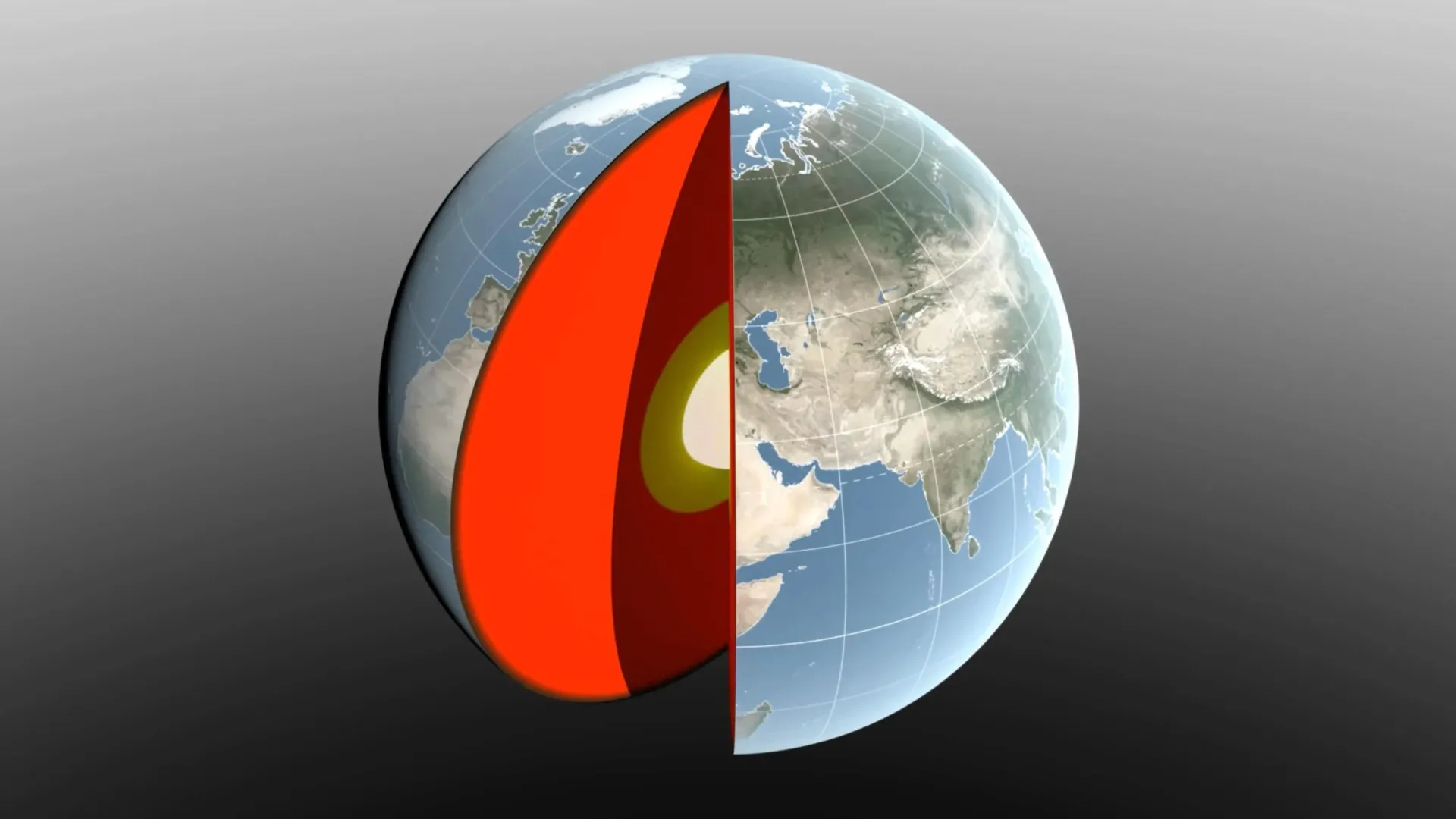
Earth’s center of mass is not a fixed point. As enormous amounts of water, ice, and air shift around the globe throughout the year, the planet's center of mass wobbles back and forth by a few millimeters relative to its geometric center.
In a new study published in Geophysical Journal International, researchers led by NASA’s Jet Propulsion Laboratory (JPL) have developed a precise satellite-tracking method to measure these subtle seasonal shifts.
Why Does the Center of Mass Move?
If Earth were a completely solid, uniform sphere, its center of mass would remain perfectly aligned with its geometric center. However, dynamic surface elements constantly shift its weight distribution:
- March: Snow accumulation across North America and Eurasia peaks, pulling the center of mass about 3 millimeters toward the North Pole.
- April: Rainwater in the Amazon River basin reaches roughly 2,400 gigatons, shifting the center 2.2 millimeters toward South America.
- August–October: Rainfall and meltwater runoff fill the oceans, pulling the center toward the South Pacific Ocean.
- November: Monsoon waters in Southeast Asia hit their seasonal peak of 600 gigatons, creating another measurable shift.
- December & June: Cold, heavy winter air mass shifts toward Asia and Northern Africa around December 21, with a corresponding atmospheric shift toward South America and South Africa around June 21.
How NASA Measures the Wobble
To calculate these microscopic movements, scientists rely on space-based satellite tracking:
- Laser Ranging Satellites: Satellites like LAGEOS 1 and 2—900-pound reflective spheres orbiting Earth—reflect laser beams sent from ground stations back to Earth to measure orbital changes.
- GPS & Orbit Adjustments: Because ground tracking stations are unevenly distributed worldwide, researchers combined laser data with GPS tracking and satellite measurements in low Earth orbit.
- Crustal Deformation Tracking: The model factors in how the weight of water and ice bends Earth's crust, causing the ground stations themselves to shift.
Using this updated method, researchers found that the annual wobble of Earth's mass center is roughly half as large as previously estimated eight years ago, indicating that seasonal fluid shifts between the Northern and Southern Hemispheres are smaller than once thought.
Why Precision Matters
While a shift of a few millimeters might seem negligible, accurate measurements are essential for global infrastructure:
- Satellite Navigation: Modern GPS networks require an accurate center-of-mass reference frame to operate reliably.
- Surface Mapping: Precision agriculture, elevation tracking, and global shipping logistics depend on precise geodetic reference systems.
- Climate & Water Tracking: Findings from this technique align with gravity measurements from the GRACE-FO satellite mission, helping scientists monitor global water displacement and ice loss.