In Brief:
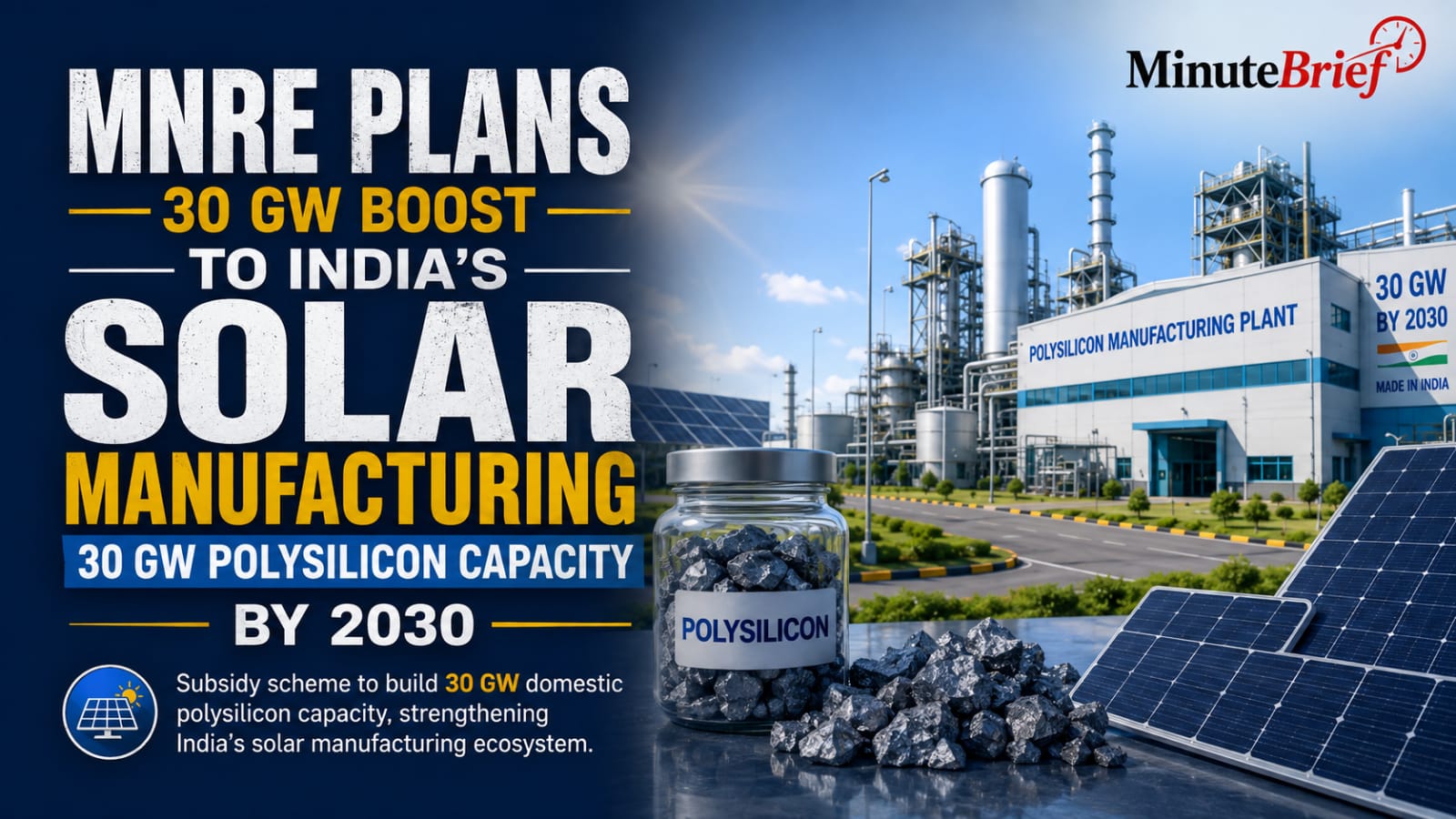
- The government aims to build a minimum of 30 GW domestic capacity for polysilicon—the key upstream raw material for solar cells and modules—by 2030.
- Setting up 1 GW of polysilicon capacity with metallurgical-grade silicon requires ~₹850 crore, bringing the total expected investment to roughly ₹25,000 crore.
- Because the existing Production-Linked Incentive (PLI) scheme is expected to yield only limited domestic polysilicon output, a dedicated financial support mechanism is being designed to cut import reliance.
The Ministry of New and Renewable Energy (MNRE) is working on a dedicated subsidy scheme to build at least 30 gigawatts (GW) of domestic polysilicon manufacturing capacity by 2030. Highlighting the initiative, Renewable Energy Secretary Santosh Kumar Sarangi stated that establishing 1 GW of integrated polysilicon plant capacity requires around ₹850 crore, translating to an estimated total investment requirement of ₹25,000 crore.
Since the current Production-Linked Incentive (PLI) framework covers the complete solar value chain but is expected to generate limited polysilicon capacity, the government is introducing this targeted support mechanism to strengthen India’s solar manufacturing ecosystem, enhance supply chain resilience, and reduce heavy reliance on imported feedstock.