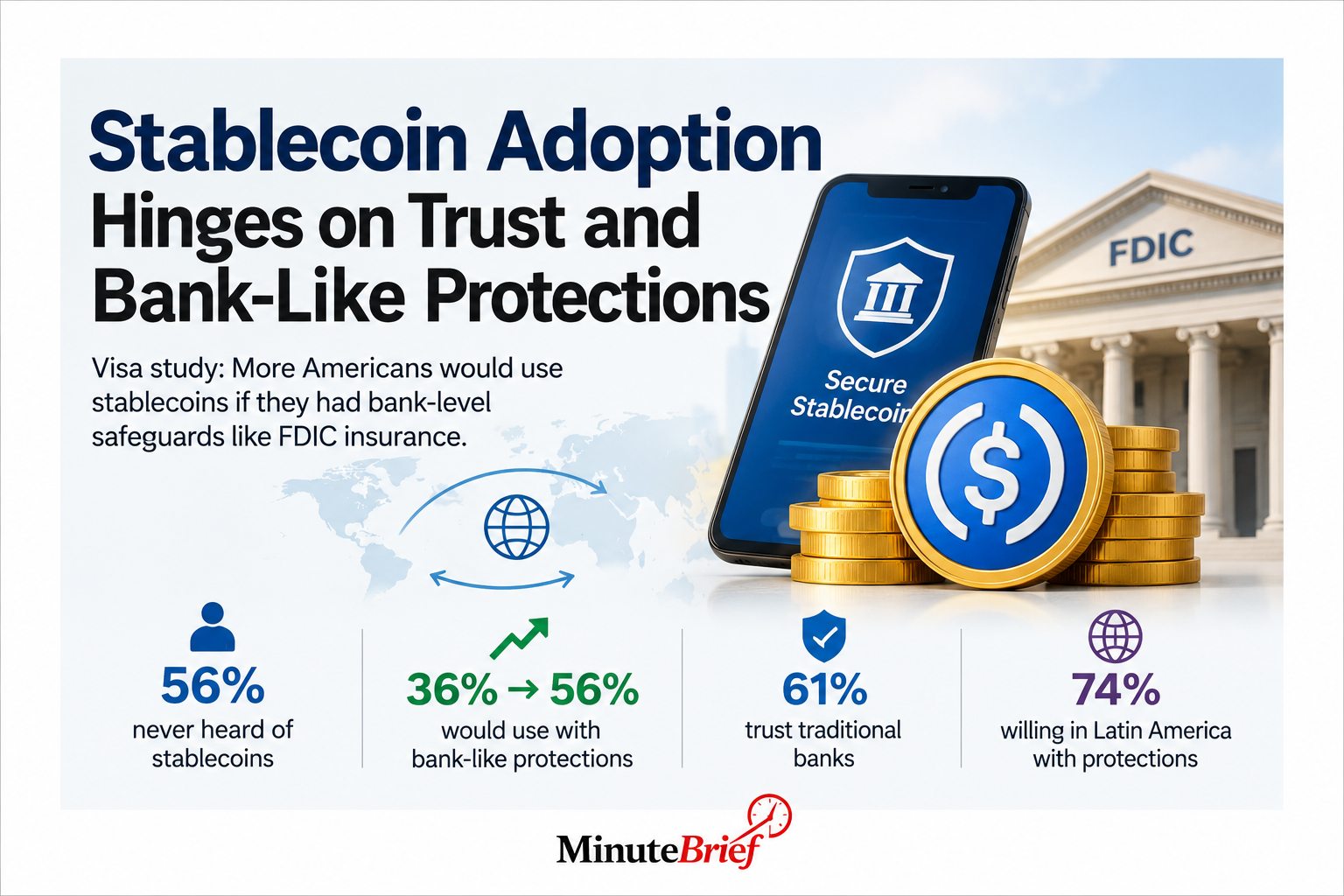
A Visa study reveals that consumer trust is crucial for the wider adoption of stablecoins. Although 56% of Americans surveyed were unfamiliar with stablecoins, willingness to use them for international transfers rose from 36% to 56% when bank-level fraud protection and deposit insurance were hypothetically offered. These findings suggest that stronger consumer safeguards could make stablecoins more familiar and acceptable to mainstream users, despite stablecoins currently lacking FDIC deposit insurance.
The survey also emphasized the importance of the service provider. Interest in stablecoins increased to 45% when offered through an existing financial provider, while 61% of Americans said they would trust a traditional bank and 60% trusted a global payment network for digital-currency services. Visa highlighted that trust, security, and consumer protection are vital for developing digital payments. The impact was even greater in Latin America, where willingness to use stablecoins for international transfers jumped from 34% to 74% under the protected scenario.
Morning Consult conducted the survey between February 24 and March 2, polling 45,445 people across 20 markets, including 2,192 U.S. adults. Visa also uncovered significant concerns about payment fraud, with 36% of U.S. remitters reporting cross-border payment scams and 44% worried about AI deepfakes impersonating family members. Meanwhile, Visa continues to expand its stablecoin infrastructure. Stablecoin settlement has reached an annualized rate above $20 billion, up from $3.5 billion when it began U.S. settlement in USDC on Solana.
Visa Direct has added stablecoin payouts through Zerohash. BlackRock estimates the stablecoin market at more than $300 billion, with over $11 trillion in adjusted transaction volume forecasted for 2025, identifying AI agents as a potential driver of future stablecoin adoption.