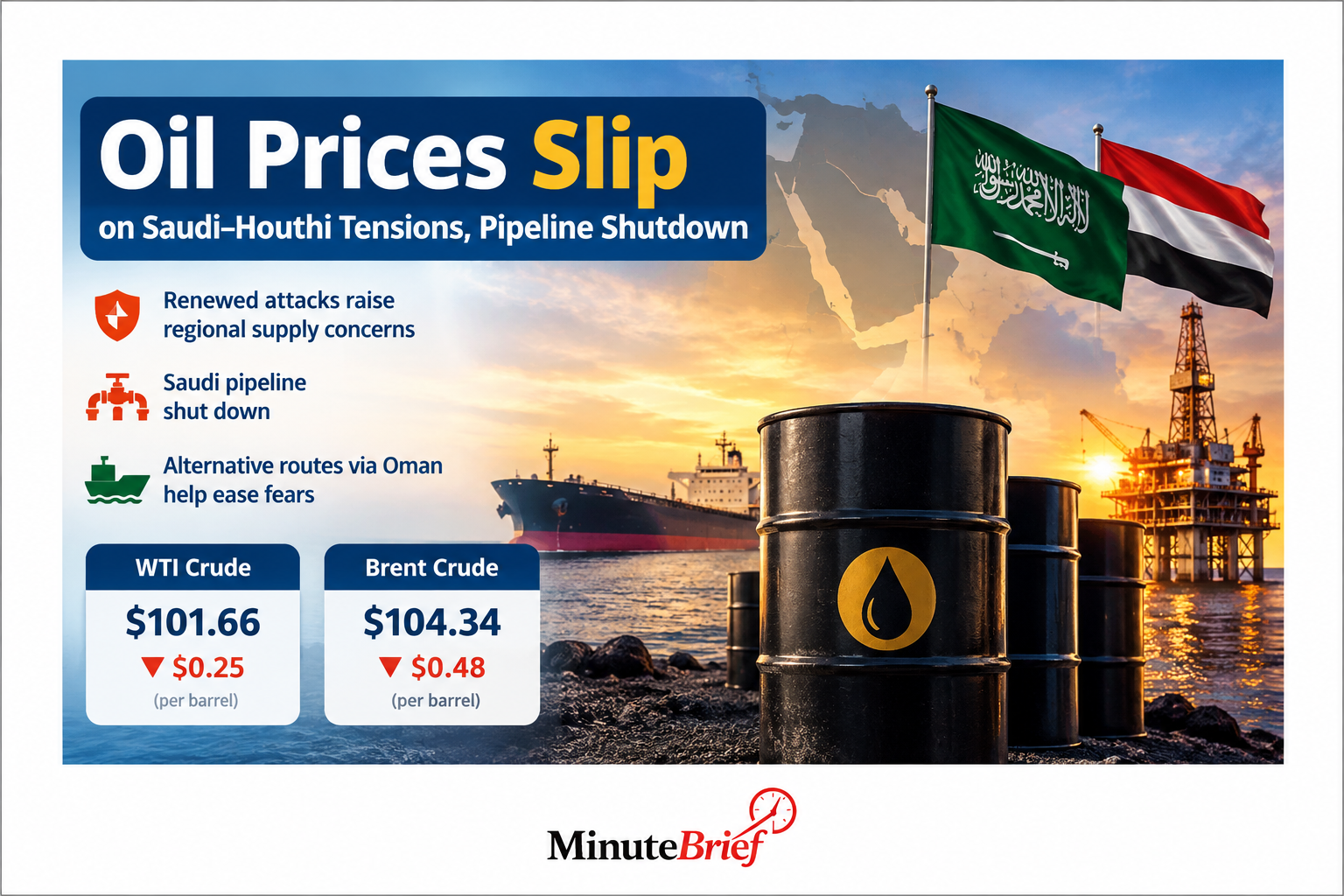
Oil prices remained largely unchanged on Friday as investors assessed the effects of renewed Saudi Arabia–Houthi attacks, the shutdown of a key Saudi pipeline, and indications that alternative export routes could sustain crude supplies to Asian buyers.
U.S. West Texas Intermediate (WTI) crude fell 25 cents to $101.66 a barrel, while Brent crude declined 48 cents to $104.34.
Despite these modest daily drops, U.S. crude rose more than 1% for the week, and Brent prices stayed broadly flat. The recent Saudi-Houthi clashes have heightened concerns about disruptions to Middle Eastern energy supplies. The conflict has strained regional oil infrastructure, and the closure of Saudi Arabia’s East-West pipeline has added uncertainty for traders.
Prolonged interruptions to pipelines, export terminals, or shipping routes could reduce crude availability globally and increase prices. However, worries about an immediate supply shortage eased after reports that Saudi Arabia is using alternative routes via Oman to deliver some crude shipments to Asia.
These alternative logistics have mitigated the amount of Saudi oil perceived at risk, partially easing the geopolitical risk premium that had pushed prices up. Simon-Peter Massabni, head of business development at XS.com, said the recent crude price decline reflects a partial reduction in geopolitical risk rather than fundamental oil market changes.
Traders remain attentive to developments near the strategic Strait of Hormuz, regional export routes, and oil terminals. The pace at which Saudi Arabia restores the East-West pipeline will also be crucial for the market outlook. Oil prices are expected to remain sensitive to geopolitical events in the near term.
Ongoing Saudi crude shipments to Asia and progress in repairing disrupted infrastructure could ease supply concerns and lower prices. Conversely, renewed attacks or broader disruptions to Middle Eastern oil exports could quickly revive geopolitical risk premiums and elevate crude prices.