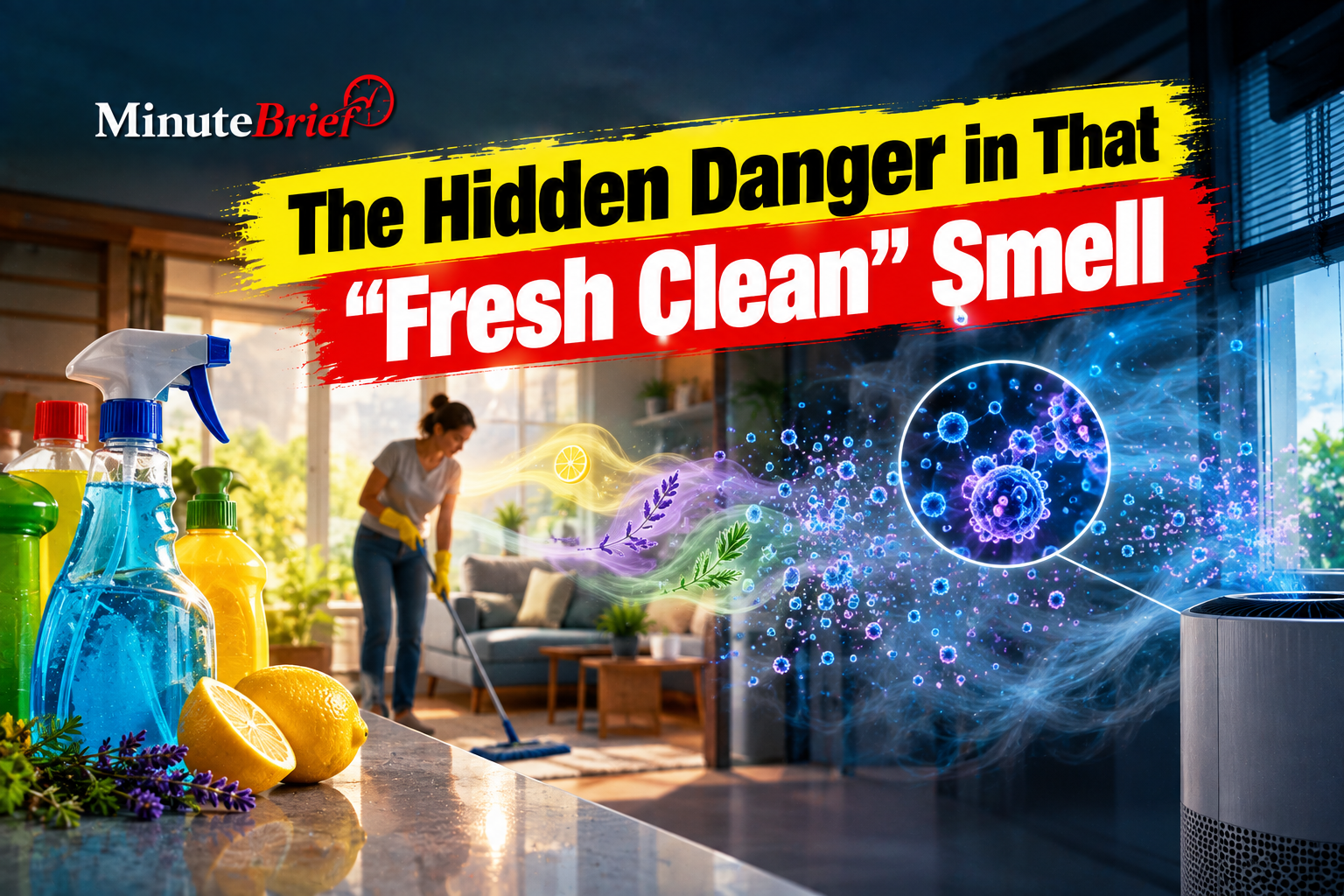
When you finish mopping or spraying down the counter, that crisp scent of lemon, pine, or lavender usually feels like a job well done. However, new research presented by the American Chemical Society reveals that familiar smell could actually be hiding a sudden spike in ultrafine indoor air pollution.
Led by Brandon Boor at Purdue University, the study found that scented cleaning products—including both conventional chemical cleaners and natural, essential oil–based products—react rapidly with indoor air to form billions or trillions of invisible nanoparticles within minutes.
The Chemistry Behind the Scent
The issue stems from fragrance compounds called terpenes, which are added to cleaning products to create pleasant scents. Common examples include:
- Limonene (citrus)
- Pinene (pine)
- Linalool (lavender)
- Thymol (thyme)
While plants naturally release terpenes outdoors, concentrations inside a home during cleaning can soar to tens or hundreds of times higher than in a dense forest. When these airborne terpenes meet trace amounts of indoor ozone, they trigger a chemical chain reaction that generates aerosol nanoparticles measuring just 1 to 30 nanometers across.
Why Nanoparticles Matter
Because these particles are so small, standard home air quality monitors won't detect them—meaning you won't see smoke, haze, or a warning light on your air purifier. Yet, their tiny size allows them to easily travel deep into your respiratory system:
- Deep Lung Penetration: They pass right through upper airway defenses to reach the deepest parts of the lungs.
- Respiratory Irritation: Once inside, they can trigger inflammation and irritation.
- High Intake: Researchers noted that the total dose of inhaled particles from routine cleaning can meet or exceed what you would breathe standing next to a busy highway.
- Potential Bloodstream Entry: Certain ultrafine particles are small enough to potentially pass through lung tissue directly into the bloodstream.
This reaction is even stronger when scented cleaners are used alongside ozone-generating devices, such as germicidal far-UV (UV-C) air disinfection lamps, which elevate ozone levels and drastically accelerate nanoparticle production.
Simple Ways to Protect Your Air
The goal isn't to stop cleaning—disinfecting surfaces remains essential for eliminating bacteria and viruses. Instead, simple habits can significantly cut down your exposure:
- Go Unscented: Choose fragrance-free or low-fragrance cleaning products and wipes. Clean air shouldn't smell like strong citrus—ideally, it shouldn't smell like anything at all.
- Ventilate the Space: Open windows or turn on exhaust fans while cleaning to keep air moving.
- Don't Layer Scents: Avoid using multiple scented sprays, wipes, and floor cleaners during the same session.
- Skip Ozone Devices: Avoid running ozone-generating air purifiers or UV lamps while actively using scented surface cleaners.