Galaxies can host hundreds of billions of stars, but every single star begins with cold, dense gas. Despite being surrounded by massive reservoirs of potential star-forming material known as the circumgalactic medium (CGM), many large galaxies stop making new stars much earlier than expected.
Now, a new study published in The Astrophysical Journal Letters by researchers at Arizona State University and the Raman Research Institute explains why: supermassive black holes may be actively blocking star formation across entire galaxies.
Tiny Objects, Massive Reach
While a supermassive black hole at a galaxy's center is relatively tiny—roughly the size of our solar system—its reach can span hundreds of thousands of light-years.
When these black holes consume gas, they launch narrow, high-energy jets of hot plasma. Astronomers discovered that these jets travel far beyond the visible galaxy and carve a path directly through the surrounding gas reservoir.
How the Discovery Was Made
Detecting the faint signals from these gas clouds around a single galaxy is nearly impossible. To overcome this, researchers combined optical data from the Dark Energy Spectroscopic Instrument (DESI) and radio measurements from the LOFAR Two-meter Sky Survey (LoTSS) across hundreds of galaxies.
The key breakthrough came down to direction:
- Everywhere else: Gas signals averaged across all directions around a galaxy appeared dim and uniform.
- Along the jet path: Ionized hydrogen gas (detected via H-alpha emissions) glowed intensely along the precise narrow beam traveled by the black hole's plasma jet.
How Jets Control Star Formation
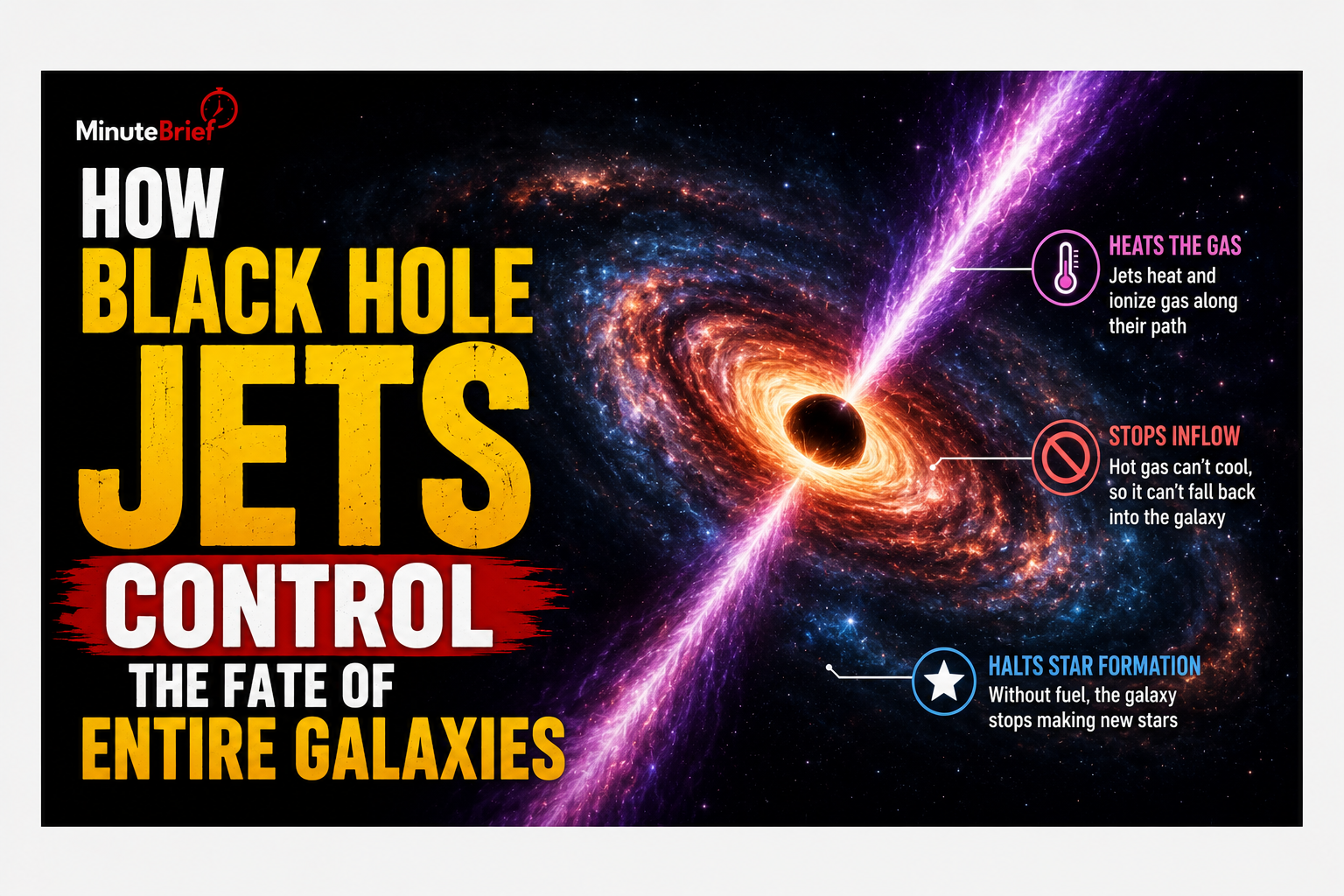
Instead of illuminating everything like a standard lightbulb, black hole jets act like powerful spotlights that heat and ionize gas along a direct beam.
By continuously stirring up and heating this surrounding gas:
- The gas stays hot: Heat prevents the circumgalactic gas from cooling down.
- Inward flow stops: Without cooling, the gas cannot gather into dense clouds or fall back into the galaxy.
- Star creation halts: Denied its primary fuel source, the galaxy eventually shuts down star production and becomes quiet.
This directional "cosmic thermostat" shows that supermassive black holes do far more than feed on nearby matter—they actively shape the long-term evolution and fate of entire galaxies.